

What Credit Score Range Qualifies as Subprime for Auto Loans?
Autocarleads | Updated April 2026 | 7 min read
Not every buyer who walks through your door fits neatly into a prime or subprime box. Credit scores exist on a spectrum and the line between tiers isn’t the same for every lender.
Understanding exactly what credit score ranges qualify as subprime for auto loans helps your team route applications to the right lender faster, structure deals more accurately, and stop wasting time submitting applications to lenders whose appetite doesn’t match the buyer’s profile.
This article covers the standard credit tiers used across the auto lending market, what each one means practically, and how the tier affects deal structure and lender selection.
Why Credit Score Ranges Matter for Auto Dealers
Most dealers know the difference between a prime and a subprime buyer in general terms. The practical value is in understanding where the lines actually fall and how lenders use those lines to make decisions.
A buyer at 638 and a buyer at 642 look identical from across the showroom floor. From a lender’s perspective, one of them may fall below the threshold for standard financing and the other may not. Routing the wrong application to the wrong lender produces a decline, adds a hard inquiry to the buyer’s report, and slows the entire process.
Knowing the tiers gives your finance team the information to make better routing decisions before the first submission, which saves time and improves approval rates.
The Standard Credit Tiers in Auto Lending
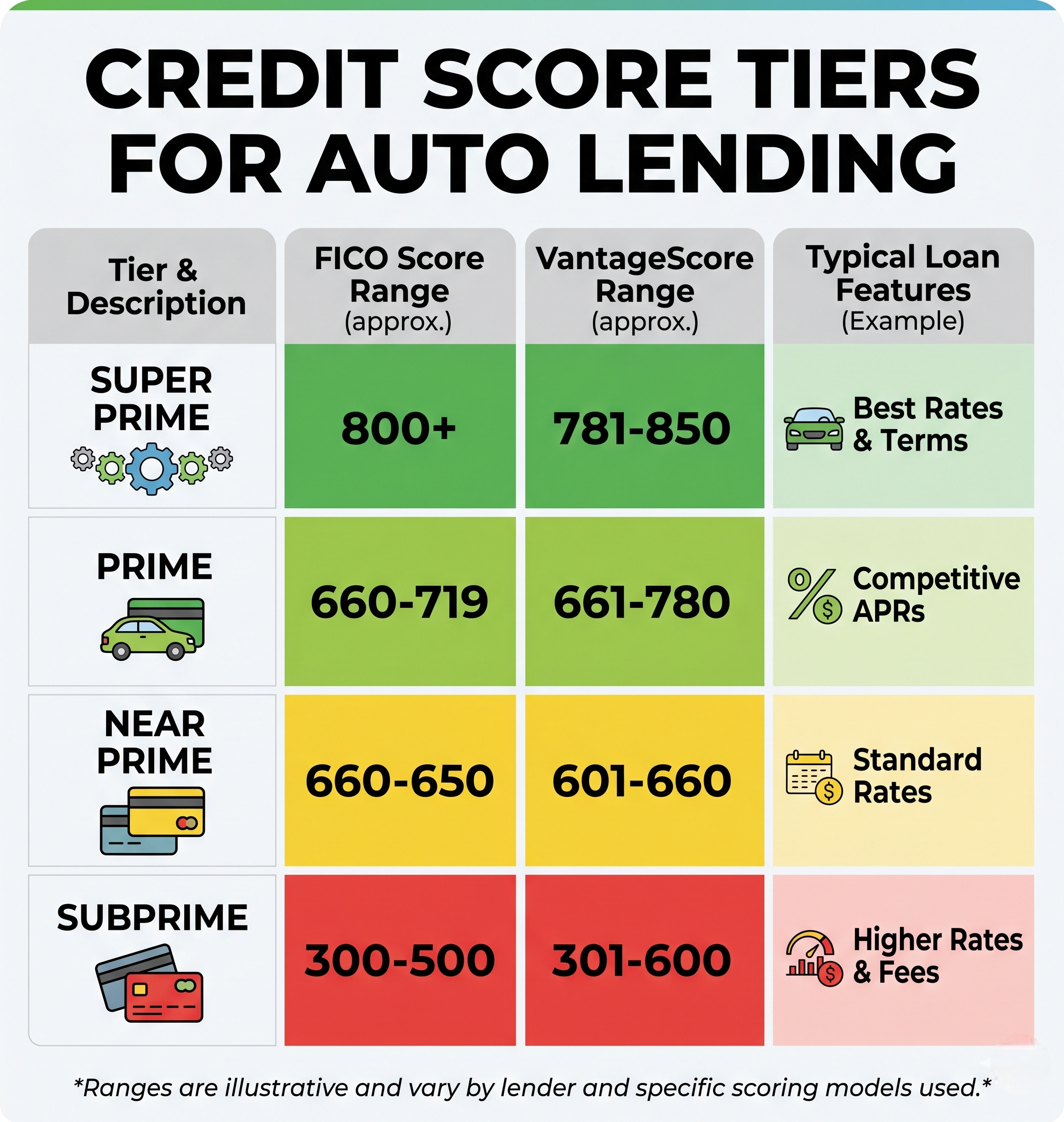
The auto lending industry uses a broadly consistent set of credit tiers though the exact boundaries vary slightly between lenders. Here’s how the market generally defines them.
Super Prime: 781 and Above
The top tier. Buyers in this range represent the lowest risk profile in the market. Lenders compete for these applications and the rates offered reflect that competition.
For dealers, super prime buyers are straightforward to finance. The priority is speed and rate competitiveness. Getting them approved quickly at the best available rate is what matters. Captive finance companies and national banks are typically your first call here.
Prime: 661 to 780
Solid credit with a strong track record. Buyers in this range qualify for most standard auto loan products at competitive rates. The approval process is generally smooth and the lender pool is wide.
Rates in this tier are meaningfully lower than subprime, which keeps monthly payments manageable even at higher vehicle price points. Most of your standard dealership volume likely falls somewhere in this range.
Near Prime: 601 to 660
This is the transition zone between prime and subprime and it’s where routing decisions start to matter more.
Near prime buyers may qualify for standard financing through some lenders but not others. Some captive finance companies have products that reach into the near prime range. Others cut off at 660 or 680. Knowing your specific lenders’ thresholds tells you whether a near prime buyer goes to a standard channel or a specialist one.
Rates in this tier are higher than prime but not dramatically so for buyers toward the upper end of the range. Deal structure matters more here than at higher tiers because the margin between an approval and a decline is thinner.
Subprime: 501 to 600
This is the core subprime range. Traditional banks and most credit unions are not useful channels for buyers in this tier. Independent finance companies that specialize in challenged credit are your primary lender options.
Rates in this tier are significantly higher than prime. Down payments are typically required. The underwriting process is more detailed and deal structure carries more weight in determining whether an application gets approved.
Buyers in this range often know their credit is challenged. They’ve usually encountered the reality of their credit score in a previous financing attempt or through checking it themselves. The conversation works better when it starts from that shared understanding rather than dancing around it.
Deep Subprime: 500 and Below
The most restricted tier in terms of lender options. Most independent finance companies have floors around 500 or slightly above. Below that threshold, buy here pay here and a small number of deep subprime specialist lenders are typically the only realistic channels.
Approval in this tier almost always requires a meaningful down payment, a vehicle within a specific price and age range, and verified stable income. Deal structure is not just important here. It’s often the difference between making the deal happen and not.
Buyers in this range sometimes have circumstances behind their score that explain it, recent bankruptcy discharge, medical debt, a specific period of financial difficulty, that provide context worth understanding before you structure the deal. Income stability and employment history carry more weight in deep subprime underwriting than in any other tier.
Where the Subprime Line Actually Falls
The short answer is that there isn’t one universal line. Different lenders draw it differently.
Most of the market uses 640 as a working threshold for standard versus subprime. Below 640 and you’re routing to subprime lenders for most applications. Above 640 and standard channels become viable.
Some lenders draw the line at 620. Others at 660. Captive finance companies often have higher floors for their standard products but separate subprime programs that extend lower. Independent finance companies typically have lower floors because their entire product is built for challenged credit.
The practical implication for dealers is that knowing your specific lender thresholds matters more than knowing the industry average. A buyer at 635 might be prime for one lender and subprime for another. Routing to the right lender for that specific score is the skill that minimizes unnecessary declines.
How Lenders Use Credit Tiers Beyond the Score
Understanding credit tiers is useful but it’s incomplete without understanding that lenders use the score as a starting point, not a final answer.
A buyer in the subprime range with strong compensating factors, stable long-term employment, a meaningful down payment, low existing debt, and stable residence history, often gets approved where a buyer with a similar score but weaker compensating factors doesn’t.
The tier tells you which lenders to approach. The compensating factors tell you how strong the application will look once it gets there.
For near prime and subprime applications, it’s worth taking a few minutes to assess the compensating factors before you submit. A deal that looks marginal on score alone might look strong when the full picture is assembled.
How Credit Tiers Affect Rate Ranges
The rate a buyer is offered reflects their credit tier and the lender’s pricing for that tier. Here’s a rough framework for what rates look like across the spectrum in the current market.
Super prime buyers typically see rates in the 4 to 6 percent range on new vehicles from competitive lenders.
Prime buyers generally see rates in the 6 to 9 percent range depending on the lender and the vehicle.
Near prime buyers typically see rates in the 9 to 13 percent range. The variation here is wider because near prime is a transition zone with more lender-to-lender variation in pricing.
Subprime buyers typically see rates from 13 to 18 percent or higher depending on how deep into the subprime range the score falls and which lenders are available in the market.
Deep subprime buyers often see rates above 18 percent. Some specialist lenders price even higher for the deepest credit profiles. The rate reflects the risk the lender is taking on and the limited competition in this tier.
What This Means for Lead Buying
Credit tier knowledge is directly useful when you’re buying leads because it tells you exactly what to filter for.
A dealership with strong subprime lender relationships and a finance team trained for this buyer profile should be filtering for leads in the subprime and deep subprime range specifically. Buying broad leads that include prime buyers the dealership isn’t set up to serve creates a mismatch that shows up in conversion rate.
A prime-focused operation should filter for near prime and above and avoid paying for subprime leads it can’t convert.
Filtering auto loan leads by credit tier is the most direct way to align your lead spend with the buyer profiles your lender relationships and deal structure capabilities can actually serve.
The lead budget works harder when the buyers it produces match the financing products available to them.
Near Prime: The Tier Worth Paying Attention To
Near prime buyers, those in the 601 to 660 range, represent one of the more interesting segments in the lead market for a specific reason.
They’re often overlooked by standard prime-focused operations and underserved by heavily subprime-focused ones. Some near prime buyers qualify for standard financing through the right lender. Others need a subprime approach but can get better rates than deep subprime buyers.
A dealership that’s set up to work both standard and subprime channels has a genuine advantage in the near prime segment. You can submit to a standard lender first and fall back to a subprime specialist if the standard channel declines. That flexibility produces more approvals and often better terms for the buyer than a single-channel approach.
Near prime leads that come in through a quality provider with accurate credit range data give your team a clear starting point for the routing decision. Inaccurate near prime classification, whether from self-reporting or poor data, creates routing confusion that slows deals and frustrates buyers.
Tracking Performance by Credit Tier
This is a habit worth building into your monthly review process if you haven’t already.
Track your contact rate, conversion rate, and cost per closed deal separately for each credit tier. The differences are often significant and they tell you exactly where your lender relationships and deal structure capabilities are strongest and where there are gaps worth addressing.
A dealership converting near prime at 18 percent and subprime at 8 percent has a subprime process problem worth diagnosing. A dealership converting subprime at 15 percent and near prime at 6 percent may have a lender relationship gap at the near prime level that’s costing it deals.
Tracking auto loan lead performance by credit tier surfaces these gaps before they become budget problems.
The Bottom Line
Credit score ranges aren’t just academic categories. They’re routing instructions.
Understanding where the tiers fall, which lenders operate in which tier, and how compensating factors affect the strength of an application within a tier is the operational knowledge that turns credit tier awareness into better approval rates and better deal structure outcomes.
Dealers who know this well route faster, submit cleaner applications, and produce more approvals from the same lead volume than dealers who route based on gut feel and hope for the best.
How Autocarleads Classifies Credit Tiers
Every lead that comes through Autocarleads includes credit range classification based on verified data rather than self-reporting. That means the tier attached to a lead actually reflects the buyer’s credit profile rather than their estimate of it.
Real-time delivery, validated contact information, and accurate credit tier filtering give your team the information it needs to route applications correctly from the first call.
See what lead options are available by credit tier in your market.
Frequently Asked Questions
Is 640 always the subprime cutoff for auto loans?
No. It’s the most commonly used threshold in the market but individual lenders set their own floors. Some draw the line at 620, others at 660. Captive finance companies often have higher floors for their standard products but separate programs that extend lower. Knowing the specific thresholds of your lender relationships is more useful than relying on the industry average.
Can a subprime buyer get prime rates with a strong co-signer?
A co-signer with strong credit significantly improves approval odds and can produce a meaningfully lower rate than the primary borrower would see alone. Whether it reaches prime rate territory depends on the lender and the co-signer’s specific profile. Some lenders price the deal based primarily on the stronger co-signer credit. Others blend the profiles. Either way, a strong co-signer is one of the most effective tools for improving terms on a subprime application.
How accurate is self-reported credit range data from buyers?
Inconsistent. Buyers frequently misjudge their own credit tier by a meaningful margin in either direction. Someone who thinks they have good credit may be near prime. Someone who thinks they’re deep subprime may actually be mid-subprime. Self-reported credit ranges are a starting point for the conversation, not a reliable basis for lender routing decisions. Verified credit range data from a quality lead provider produces more accurate routing from the first call.
Does the credit tier affect which vehicle types a buyer can finance?
Indirectly yes. Subprime lenders are typically more restrictive on vehicle age and mileage than prime lenders because older, higher-mileage vehicles are harder to value accurately as collateral. A deep subprime buyer may find that newer, lower-mileage vehicles in a specific price range are the only options that underwrite cleanly. Knowing this before you start showing inventory saves time and manages expectations from the start of the conversation.
How often do credit tier boundaries change in the auto lending market?
The tiers themselves are relatively stable but where individual lenders draw their floors can shift with broader economic conditions. During periods of economic stress, some lenders tighten their credit requirements and raise their minimum scores. During competitive periods, some lower them to capture more of the market. Staying current with your specific lender relationships on their current credit appetite is more reliable than assuming last year’s thresholds still apply.