
How to Convert Subprime Leads Into Closed Deals
Autocarleads | Updated April 2026 | 8 min read
Subprime leads convert differently from standard credit leads.
That’s not an opinion. It’s something every dealer who has worked both markets figures out fairly quickly.
The buyers are in a different emotional place..
The lender routing requires more precision.
The deal structure demands more attention.
And the follow-up that works for a prime buyer often falls flat with someone who isn’t sure whether approval is even possible for them.
Converting subprime auto leads into closed deals consistently requires a process built specifically for this buyer profile, not a standard sales approach applied to a harder situation.
This article covers the specific differences in approach, the common points where subprime deals fall apart, and what the dealerships consistently closing in this market are doing that others aren’t.
Why Subprime Conversion Is Different
Start with the buyer’s mindset.
A prime buyer walks in expecting to get approved. The conversation is about rate, vehicle, and terms. The financing is a logistics question, not an emotional one.
A subprime buyer often walks in expecting to be told no. They may have been declined elsewhere. They may have spent years hearing that their credit is a problem. By the time they submit a lead or walk through your door, there’s often a layer of defensiveness or resignation sitting underneath the inquiry.
That context changes everything about how the first conversation needs to go. A buyer who’s braced for rejection responds very differently to a standard sales opener than one who came in expecting an easy process.
The dealerships that convert subprime well don’t ignore that context. They work with it.
The First Call: What Changes
Speed still matters in subprime. Calling within five minutes of lead submission applies here just as much as it does for standard credit leads. Intent fades regardless of credit tier.
What changes is the opening.
A standard credit opener is often about the vehicle. What are you looking for? What’s your timeline? Can we get you in this weekend?
A subprime opener needs to start somewhere different. The buyer submitted a financing inquiry, not a vehicle inquiry. They’re not primarily thinking about which truck they want. They’re thinking about whether financing is even possible for them.
Starting the conversation there meets them where they actually are.
Something like: “Hey, I saw you were looking into financing options. I wanted to reach out because a lot of people in your situation end up surprised by what’s actually available to them. Do you have a few minutes?”
That framing does several things. It acknowledges why they reached out without making it awkward. It creates a small curiosity gap around “surprised by what’s available.” And it asks for time without demanding it.
The goal of the first call isn’t to close. It’s to open a real conversation and create enough trust that the buyer stays engaged for the next step.
Qualifying the Right Things Early
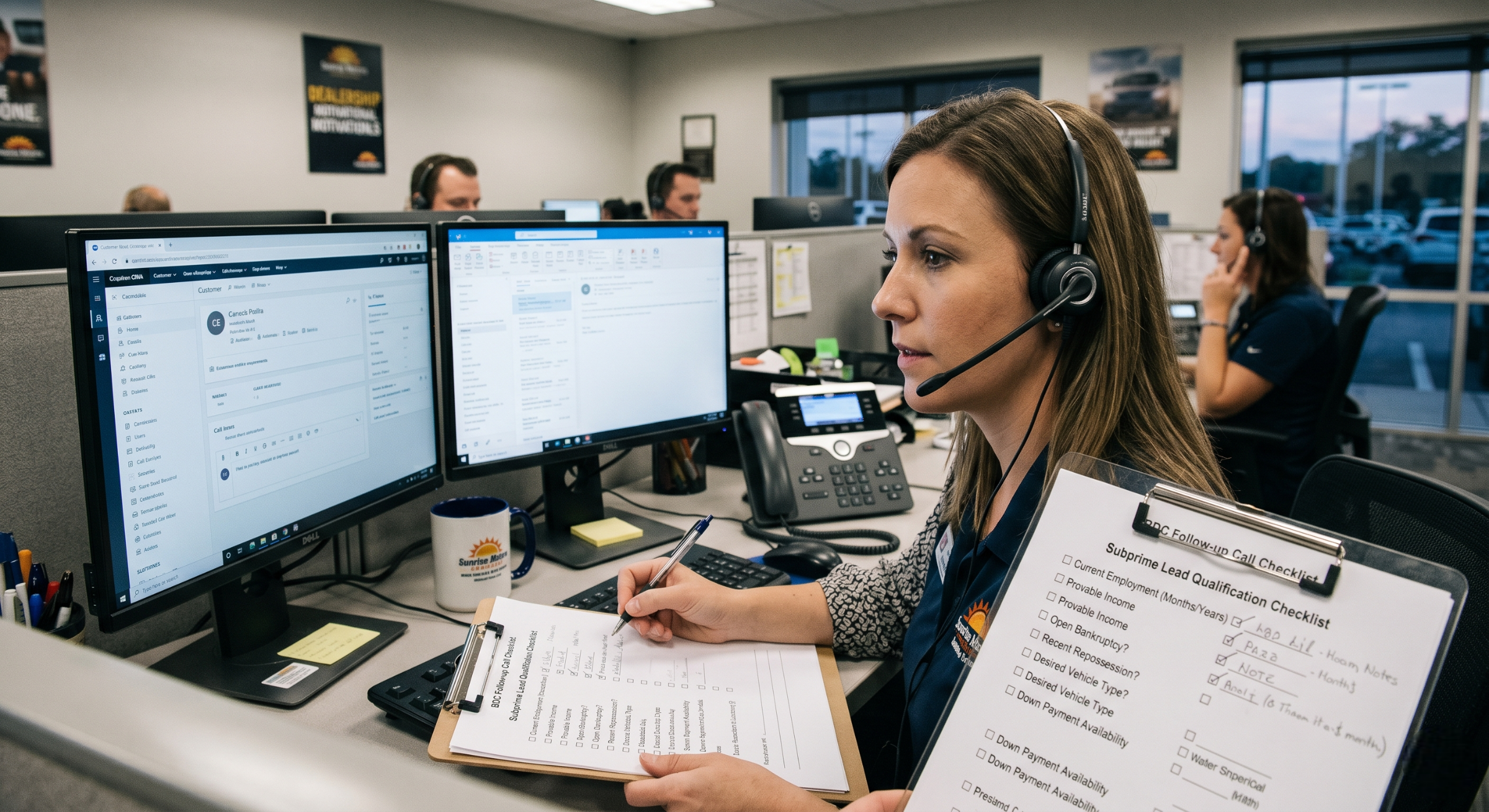
In standard credit deals, qualification is mostly about vehicle preference and budget. In subprime deals, there are specific questions that need to be answered early because the answers determine whether the deal can be structured at all.
Down payment
Most subprime lenders require a down payment. Finding out early whether the buyer has one, and how much, tells you whether the deal has a realistic path before you’ve invested significant time in it.
Ask it directly and naturally. “Most lenders in your credit range are going to want to see something down. Do you have anything available for that or is that something we’d need to work around?”
If they have a trade-in, that equity counts. If they have some cash available, that changes the conversation significantly. If they have nothing and the lender requires a minimum, that’s important to know now rather than after a decline.
Income verification
Subprime lenders lean heavily on income as a compensating factor for the credit score. Knowing the buyer’s income and employment situation early tells you which lenders are realistic options and what payment range will underwrite cleanly.
This isn’t interrogating the buyer. It’s framing it as the information you need to find them a real option. “To figure out which lenders are going to be the best fit for your situation, I need to understand roughly what your income looks like. Are you working full-time right now?”
Employment stability
Time at current job matters to subprime lenders. A buyer with 18 months at the same employer is a different conversation from one who started a new job last month. Finding this out early helps you assess which lenders to approach.
Lender Routing: Getting It Right the First Time
One of the most common reasons subprime deals fall apart before they should is submitting to the wrong lender.
A decline from a lender whose threshold doesn’t match the buyer’s profile isn’t a deal killer on its own. But it adds a hard inquiry to a credit report that’s already challenged, slows the process, and sometimes discourages buyers who interpret a decline as a final answer rather than a routing error.
Knowing your lenders’ specific criteria before you submit saves all of that.
Most specialist subprime lenders have published or accessible tier guidelines that tell you their minimum score, their down payment requirements, their vehicle age and mileage limits, and their payment-to-income thresholds. Reading those guidelines and routing based on them rather than on intuition produces a cleaner approval process.
For a buyer at 565 with $1,200 down and two years at the same employer, there’s a specific set of lenders that profile fits. Submitting there first, rather than to the lender you happened to call last, is the difference between a clean first-attempt approval and a frustrating back-and-forth.
Building your subprime lender routing knowledge is the operational investment that produces consistently better first-attempt approval rates without requiring better leads.
Deal Structure: Getting the Numbers Right Before You Submit
A poorly structured subprime deal doesn’t just get declined. It tells the lender something about how the dealership operates that affects how future submissions are received.
Structure the deal before you submit it. Not after.
Payment-to-income ratio
Calculate it before the submission. Take the proposed monthly payment and divide it by the buyer’s gross monthly income. If the ratio exceeds 15 to 20 percent, the lender is likely to decline or counter. Adjusting the vehicle price, down payment, or term before you submit addresses the issue rather than creating a cycle of declines and resubmissions.
Loan-to-value ratio
Know the book value of the vehicle before you submit. Calculate the LTV based on the proposed loan amount. Most subprime lenders want to stay at or below 110 to 120 percent LTV. A deal structured above that threshold needs either a higher down payment or a lower vehicle price before it will underwrite.
Term selection
Longer terms reduce the monthly payment but some subprime lenders cap terms at 60 or 72 months. Know your lender’s term limits before you structure the deal around a term they won’t approve.
Getting these three numbers in order before submission takes 10 minutes and prevents most structural declines. It’s the kind of preparation that separates finance managers who close subprime deals consistently from the ones who submit and hope.
Handling the Rate Conversation
This is the part of the subprime sales process that most finance managers handle poorly, often by avoiding it until the last possible moment.
Subprime buyers are going to see a higher rate than standard credit buyers. Most of them already know their credit is challenged. Waiting until the closing table to tell them the rate is 16 percent when they were expecting something closer to standard rates creates a feeling of being misled, regardless of whether that was the intent.
Have the rate conversation early. Frame it honestly and constructively.
Something like: “Based on where your credit is right now, the rate is going to be higher than what you’d see with stronger credit. You’re probably looking at somewhere in the 14 to 18 percent range depending on which lender we match you with. The good news is that if you make your payments consistently over the next 12 to 18 months, you’ll be in a position to refinance at a significantly lower rate. A lot of people use this first loan specifically to rebuild their credit and then refinance once the score has moved.”
That conversation does several things. It sets accurate expectations. It reframes the higher rate as a temporary condition rather than a permanent one. And it gives the buyer a reason to commit to the loan beyond just getting a vehicle.
Buyers who understand the full picture make better decisions and feel better about those decisions. That matters for the relationship beyond the closing table.
Follow-Up for Subprime Leads
The standard multi-touch follow-up sequence applies to subprime leads with some modifications.
More touches are often needed before a subprime buyer is ready to have a productive conversation. A buyer who’s uncertain about whether approval is possible may need more contact attempts before they engage, not because they’re uninterested but because they’re skeptical about the outcome.
Adjust the messaging between touches to reflect where the buyer likely is mentally. The first contact is an introduction and an offer to help. The second is a follow-up that acknowledges you haven’t connected yet. The third and fourth are opportunities to give the buyer a reason to respond that they haven’t heard yet.
“I wanted to let you know that we’ve worked with a lot of buyers in similar credit situations and found paths to approval that surprised them. I’d rather spend five minutes on the phone with you and tell you honestly what’s possible than have you assume the answer is no.”
That kind of language creates a different pull than a standard check-in message.
Patience matters in subprime follow-up in a way it sometimes doesn’t with prime leads. A buyer who doesn’t respond for a week and then calls back on day nine because they’ve decided they’re ready is a real pattern in this market. Don’t abandon the lead after five days just because the timeline is longer than you’re used to.
What Kills Subprime Deals Mid-Process
A few specific patterns account for most of the deals that start well and fall apart before they close.
Down payment surprises
The buyer said they had $800 down. The lender requires $1,500. Nobody confirmed the specific requirement before the buyer committed emotionally to a vehicle. Now there’s a gap that kills the deal at the worst possible moment.
Confirm the lender’s minimum down payment requirement before the buyer starts picking out a vehicle. Set the expectation clearly. If there’s a gap, address it before anyone gets attached to a specific car.
Income verification problems
The buyer’s actual verifiable income is lower than what they stated. Self-employment with inconsistent deposits, informal income that doesn’t show up on pay stubs, or recent job changes that leave gaps in the documentation all create verification problems that surface at submission.
Ask about income in enough detail early in the conversation that you know what documentation will be available before you submit. A buyer whose income story is complicated deserves a frank conversation about what lenders will and won’t count before the application goes in.
Vehicle selection that doesn’t fit the lender’s criteria
The buyer fell in love with a 2011 vehicle with 130,000 miles. The lender you’re planning to use won’t finance anything over 100,000 miles. Nobody checked until after the buyer spent an afternoon test driving it.
Know your lenders’ vehicle restrictions before you start showing inventory to a subprime buyer. Set the parameters at the start of the inventory conversation so you’re showing vehicles that will actually underwrite.
Emotional detachment after a decline
A first-attempt decline on a subprime application is common. It’s a routing or structure issue in most cases, not a verdict on the buyer’s eligibility. But buyers who’ve already experienced rejection from other lenders sometimes interpret an internal decline as confirmation that approval isn’t possible.
How you handle the first decline in front of the buyer determines whether the deal continues or ends there. Framing it as a routing adjustment rather than a rejection, and immediately discussing the next step, keeps the process moving.
Building Long-Term Value From Subprime Customers
This section matters more than most dealerships give it credit for.
A subprime buyer who gets into a reliable vehicle through a dealership that treated them fairly and helped them understand the process doesn’t just close one deal. They come back when they’re ready to refinance. They send family members who are in similar credit situations. They refer friends who assume they can’t get approved anywhere.
The referral rate from satisfied subprime customers is consistently higher than most dealerships expect, specifically because this buyer has often had bad experiences elsewhere and the contrast with a good experience is memorable.
Following up after the sale matters too. A check-in at the six-month mark, a reminder about refinancing options at the 12-month mark, and consistent communication that treats them as a valued long-term customer rather than a one-time deal creates a relationship that produces compounding returns.
Building a long-term relationship strategy around subprime auto customers is one of the most underinvested opportunities in this market.
The Bottom Line
Subprime conversion is a skill. It requires a specific approach to the first call, specific qualification questions early in the process, precise lender routing, careful deal structure before submission, and a follow-up process that accounts for buyers who need more time and more touches than standard credit leads.
Dealerships that build that capability consistently close more deals from the same lead volume than the ones applying a standard process to a market that requires a different one.
The buyers are real. The need is real. The path to approval exists for most of them with the right structure and the right lender. Getting them there is the job.
How Autocarleads Supports Subprime Conversion
Every subprime lead that comes through Autocarleads is intent-verified, contact-validated, and matched to your geographic market. Credit range classification is based on verified data so your team knows what tier they’re working with from the first call and can route accordingly.
Real-time delivery means your team reaches buyers while the intent behind the inquiry is still fresh. In the subprime market, that timing matters even more than it does in standard credit because the window where a buyer is actively engaged in the process is sometimes shorter and more fragile.
See what subprime lead options are available in your market.
Frequently Asked Questions
What's the most important factor in converting subprime auto leads?
Speed to contact combined with a follow-up approach that’s calibrated for a buyer who’s uncertain about whether approval is possible. The first call is about creating enough trust and enough hope that the buyer stays engaged for the next step. Everything else, lender routing, deal structure, rate conversation, follows from getting that first real conversation established.
How many contact attempts should we make on a subprime lead before giving up?
More than on standard leads. Five to eight attempts across phone, text, and email within the first week, followed by a longer-term nurture sequence, is the standard that produces the best results in this market. Subprime buyers sometimes take longer to engage because they’re uncertain about the outcome. Persistence within a structured sequence signals that you’re genuinely trying to help rather than just working through a list.
Should the same finance manager handle subprime leads from first contact through to close?
Where possible yes. Continuity matters more in subprime than in standard credit deals because trust is harder to build and more easily disrupted. A buyer who’s had a real conversation with one person and gets transferred to a different person at a critical moment loses the rapport that was doing part of the work. Keep the relationship consistent where team structure allows it.
How do we handle a buyer whose credit is worse than expected when we pull it?
Honestly and immediately. If the score comes back lower than the buyer indicated and it changes what’s available, have that conversation directly. Explain what the pull showed, what it means for the lender options, and what the adjusted path forward looks like. Buyers who receive honest information and a real plan to work with it respond better than those who find out at the closing table that the deal they thought was happening isn’t.
Is it worth investing in subprime leads if our lender relationships in that tier are limited?
Build the lender relationships first. Subprime leads without the lender infrastructure to approve them produce declines and frustrated buyers rather than closed deals. Two or three strong specialist subprime lender relationships give you real flexibility across most of the subprime range. Once those relationships are in place, a consistent pipeline of quality subprime leads converts at rates that make the investment clearly worthwhile.