
Exclusive vs. Shared Auto Leads: Why It Matters for Your ROI

Autocarleads | Updated April 2026 | 7 min read
If you’ve ever bought leads and wondered why your closing rate felt.. lower than it should, there’s a good chance the answer has less to do with your follow-up and more to do with what kind of lead you were working with in the first place.
Exclusive leads and shared leads are NOT the same thing.
They don’t convert the same way, they don’t require the same approach, and they absolutely don’t deliver the same return on your investment.
Understanding the difference before you spend another dollar on lead generation is one of the more useful things you can do for your bottom line.
So, let’s get into it!
What Is a Shared Auto Lead?
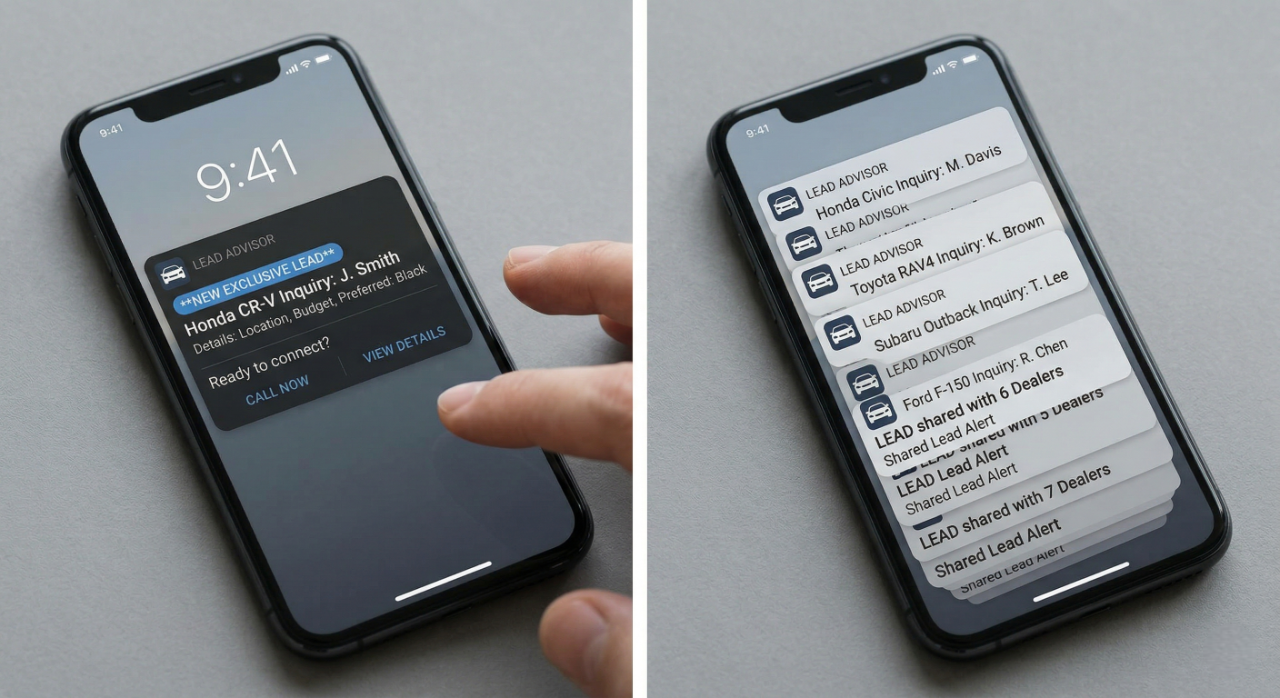
A shared lead is exactly what it sounds like. One buyer fills out a form and that lead gets sold to multiple dealerships or finance teams at the same time. Could be two, could be five, could be more depending on the provider.
The buyer submitted one inquiry. Multiple businesses are now calling them.
The upside is cost. Shared leads are cheaper per lead because the provider is selling the same lead more than once and spreading the cost across multiple buyers. If you’re working with a tight budget and a fast follow-up process, shared leads can still work.
The downside is competition. The moment that lead hits your desk it’s also hitting someone else’s. Speed becomes the only real differentiator and even then you’re not guaranteed to be first. The buyer is about to get multiple calls, multiple offers, and multiple pitches. That changes the dynamic of the conversation significantly.
What Is an Exclusive Auto Lead?
An exclusive lead is sold to one buyer only. One dealership, one finance team, one shot at that customer. Nobody else is calling them from the same inquiry.
The cost per lead is higher. That’s the honest tradeoff. But what you’re paying for is the absence of competition, and that changes everything about how the conversation goes.
When you call an exclusive lead, the buyer isn’t already comparing you to three other dealers they just spoke to. They haven’t been pitched twice before you got to them. You’re the first and only call they’re getting from this inquiry, which means the conversation starts warmer and moves faster.
How Each Model Affects Your Closing Rate
This is where the real math lives.
A shared lead might cost you $20. An exclusive lead might cost you $60. On the surface the shared lead looks like the better deal. Three leads for the price of one.
But if your closing rate on shared leads is 8 percent and your closing rate on exclusive leads is 25 percent, the math flips completely. You’re spending more per lead but significantly less per closed deal. And closed deals are the only number that actually matters.
The dealerships that figure this out early stop thinking about cost per lead and start thinking about cost per closed auto loan deal, which is the metric that actually tells you whether your lead spend is working.
The Speed Problem With Shared Leads
With shared leads, speed isn’t just important. It’s basically the whole game.
Studies on lead response consistently show that contacting a lead within the first five minutes of submission produces conversion rates many times higher than waiting even an hour. With shared leads that window gets even narrower because you’re not just racing the clock, you’re racing every other dealership that received the same lead at the same time.
If your team isn’t set up to respond immediately, and most teams aren’t, shared leads are going to underperform regardless of their quality. The infrastructure required to actually win on shared leads consistently is significant, and a lot of dealerships underestimate that going in.
When Shared Leads Can Still Work
Shared leads aren’t always the wrong choice. There are situations where they make sense.
If you have a dedicated BDC team with fast response times and a strong follow-up sequence, you can compete effectively on shared leads. Volume matters here. If you’re buying enough of them and converting at even a modest rate, the economics can work.
Shared leads can also work well for subprime auto financing teams who are comfortable with a longer, more consultative sales process and can differentiate through patience and approach rather than just being first to call.
The key is going in with honest expectations about what shared leads require and making sure your process is actually built to handle them.
When Exclusive Leads Are Worth Every Penny
If your team is smaller, your follow-up process is more personalized, or you’re in a competitive market where being one of five callers is genuinely hurting your conversion rate, exclusive leads tend to pay for themselves quickly.
You also tend to get better conversations. A buyer who hasn’t already been through three sales pitches before you called is more open, less guarded, and easier to actually help. That’s not nothing. Especially in auto financing where trust plays a significant role in whether someone moves forward.
For dealerships focused on building long-term customer relationships rather than just filling the floor with one-time transactions, the exclusive model also tends to produce better quality customers who are more likely to return and refer.
What to Ask Any Lead Provider Before You Buy
Before you commit to a lead source, get clear on a few things.
How many times is each lead sold? If they can’t give you a straight answer on this, that’s your answer.
How fresh are the leads? Time between form submission and delivery matters enormously. A lead that sat for 24 hours before reaching you is already a different conversation than one that arrives within minutes.
How are leads verified? A phone number that doesn’t work isn’t a lead. A good provider validates contact information before anything reaches your desk.
What’s the geographic targeting? Auto loan leads matched to your specific market are worth considerably more than leads pulled from a broad region with no real filter on location.
The Bottom Line
Exclusive and shared leads both have a place in a dealership’s lead strategy. But they’re not interchangeable and treating them like they are is a good way to spend money without understanding why it isn’t working.
Shared leads reward speed and volume. Exclusive leads reward process and relationship. Know which one your team is actually built for before you decide where to put your budget.
The dealerships that consistently outperform on lead ROI are the ones who stopped buying leads based on price per lead and started buying them based on what each model actually costs them to close a deal. That’s the whole shift.
How Autocarleads Gives You the Edge on Lead Quality
Most lead providers will sell you whatever you’ll buy. Volume, shared lists, recycled data, it all looks the same on an invoice.
Autocarleads works differently. Every lead that comes through is pre-screened, intent-verified, and matched to your market before it reaches your team. Whether you’re looking for exclusive leads to maximize your closing rate or a high-volume shared model to feed a larger BDC operation, the leads are real, the contact information is validated, and you’re not competing against stale data.
If you’ve been frustrated by lead quality or trying to figure out why your conversion numbers aren’t where they should be, the conversation usually starts with understanding exactly what you’ve been working with.
See what’s available in your area and how Autocarleads matches leads to your market.
Frequently Asked Questions
Is it worth paying more for exclusive auto leads over shared ones?
It depends entirely on your closing rate and your cost per closed deal. If you’re currently converting shared leads at a low rate, the math on exclusive leads often works out in your favor even at a higher cost per lead. Run the numbers on what you’re actually paying per closed deal under each model and the answer usually becomes clear.
How many times is a typical shared auto lead sold?
This varies by provider and most won’t advertise the number openly. Some cap it at two or three buyers, others sell to five or more. Before committing to any shared lead provider, ask directly how many times each lead is distributed and get that answer in writing if possible.
Can a dealership use both exclusive and shared leads at the same time?
Absolutely, and a lot of high-performing dealerships do exactly that. Exclusive leads typically go to their highest-performing closers for maximum conversion, while shared leads feed a BDC team focused on volume and speed. Running both models in parallel lets you test what works best for your market and your team structure.
How does lead exclusivity affect the buyer's experience?
Significantly. A buyer who submitted one inquiry and received five calls within an hour is going to be more guarded, more price-focused, and harder to build rapport with. A buyer receiving one call from one dealership tends to be more open to an actual conversation. That difference in buyer experience translates directly into your conversion rate.
What should a dealership's response time be for exclusive auto leads?
Even with exclusive leads, faster is always better. The buyer is still in the mindset they were in when they submitted, and reaching them while that intent is fresh produces the best conversations. Aim for under five minutes where possible. Even with exclusivity working in your favor, waiting hours or days to follow up wastes the advantage you paid for.