
TL;DR — Quick Summary
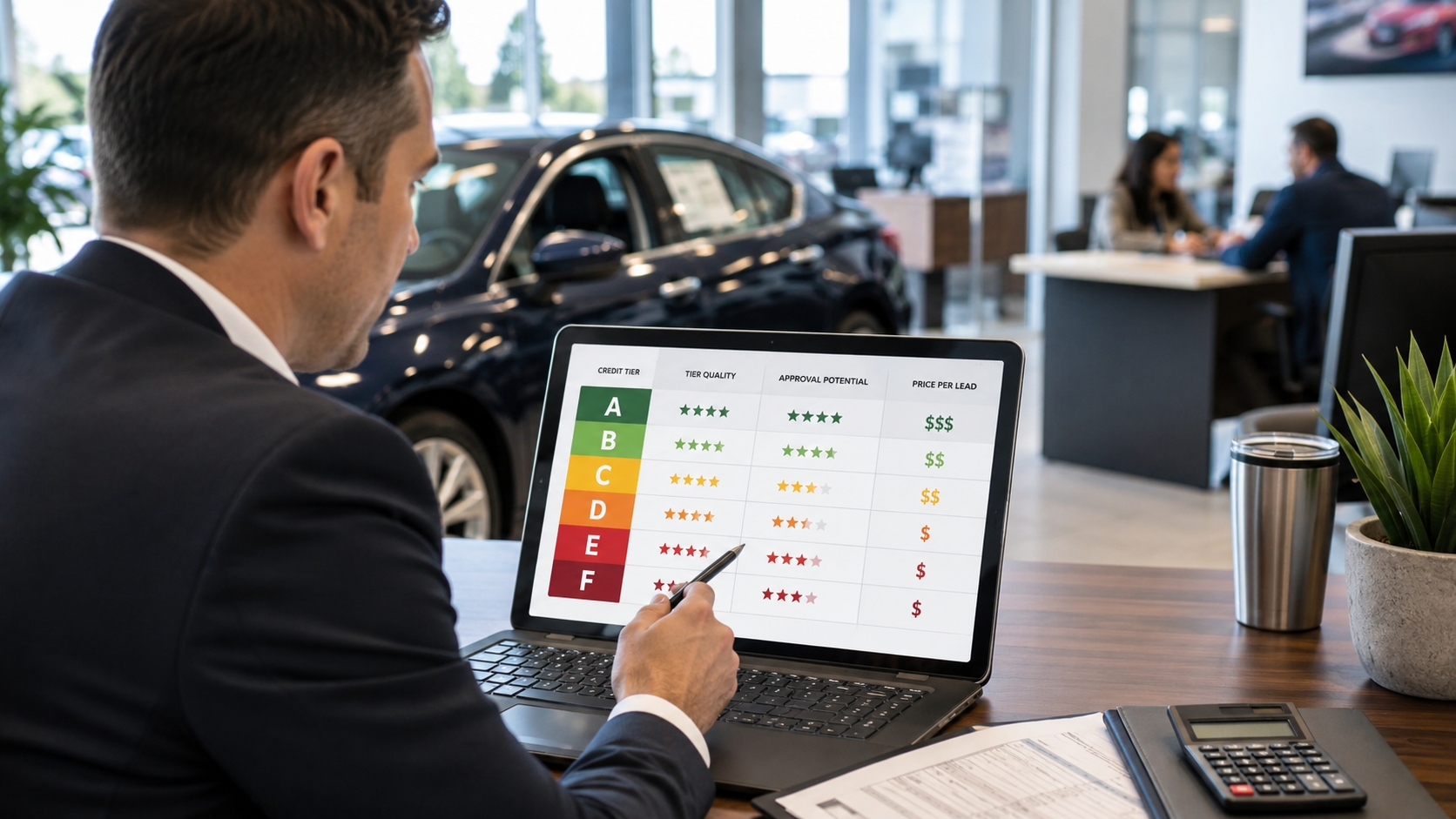
- Credit tier pricing for auto leads varies significantly — A-tier prime leads typically cost more per unit, while D–F subprime leads carry higher risk premiums but deliver larger back-end gross when closed.
- A–F credit tiers map directly to beacon score ranges, with A (720+) through F (below 500 or discharged bankruptcy) each requiring different lender routing and deal structure.
- Subprime leads (D–F) are not inherently low-value — dealers with strong lender relationships and F&I expertise routinely close 6–15% of subprime leads at higher backend margins.
- Pre-screening and income verification are the most reliable quality signals across all tiers — a verified D-tier lead outperforms an unverified B-tier lead in conversion rate.
- Autocarleads supplies pre-screened leads across all credit tiers, geo-targeted to your territory, with no shared distribution and a lead replacement guarantee.
Not all car loan leads are priced the same — and they shouldn’t be. Credit tier pricing for auto leads reflects the underwriting risk, lender availability, and expected deal complexity associated with each borrower profile. For dealer principals and F&I managers buying leads at volume, understanding how A through F tiers affect both price and profit is the difference between a lead program that pays out and one that drains budget.
The Canadian auto finance market runs on credit tiers. Every lender — from TD Auto Finance to Rifco and CarFinco — uses them to determine rate, LTV, and program eligibility. Lead providers use them too, to signal what kind of buyer is on the other end of that application. Understanding the A–F framework means you stop buying on price and start buying on ROI.
This guide breaks down each credit tier, what it means for lead cost, deal structure, and lender routing — and how to build a lead mix that maximizes gross across your entire portfolio.
AUTOCARLEADS
Not sure which credit tiers are right for your dealership’s lead mix?
Autocarleads can walk you through lead volume, tier distribution, and territory availability — no obligation. Book a free call with Phil or Steph and get a clear picture of what’s available in your market.
What the A–F Credit Tier System Actually Means
The A–F tier system is a standardized shorthand for beacon score bands and associated credit risk. In the Canadian auto finance context, the tiers typically map as follows: A-tier (720–900) covers prime and super-prime borrowers who qualify with major banks at preferred rates. B-tier (660–719) represents near-prime buyers who generally qualify through major banks or credit unions with modest rate premiums. C-tier (600–659) lands in the non-prime zone — approvals are available but typically through alternative lenders at higher rates and stricter LTV caps.
D-tier (550–599) enters subprime territory. Lenders like Rifco, CarFinco, and Westlake Financial are active here, but deals require stronger income verification and may carry 20–30% interest rates. E-tier (500–549) represents deep subprime — approvals exist but require significant down payment, proof of stability, and the right lender match. F-tier (below 500, or active/discharged consumer proposal or bankruptcy) is the highest-risk segment. Not every lead in this tier can be funded, but for dealers with the right lender panel and F&I process, funded F-tier deals carry among the highest backend margins in the business.
When a lead provider assigns a credit tier, they are telling you which lender group to route the deal through — not whether the deal is worth pursuing. Understanding how lead quality intersects with credit tier is what separates dealers who close consistently from those who constantly complain that “subprime leads don’t work.”
How Credit Tier Affects Auto Lead Pricing
Lead pricing by credit tier follows a straightforward risk-premium model: the harder the deal is to fund, the higher the cost to originate — and in some programs, the higher the cost to acquire. A-tier and B-tier leads are typically priced at a modest premium because lender optionality is high and conversion timelines are shorter. The buyer is easier to fund, the deal closes faster, and front-end gross is predictable.
“Dealers working Autocarleads’ subprime lead pipeline report 6–15% close rates on pre-screened applications — a figure that reflects income-verified, QA-reviewed contacts, not raw internet inquiries.”
D through F leads carry higher per-lead costs in some programs because acquisition involves more qualification effort — income verification, reference checks, and intent confirmation all take time before the lead is delivered. What dealers often miss is that the margin on a funded subprime deal frequently exceeds the margin on a prime deal by $1,500–$3,000 in F&I backend alone. When you factor that into your cost-per-funded-deal math, D–F leads often outperform their sticker price.
The real cost variable is not the tier — it is whether the lead was pre-screened before delivery. A cold D-tier lead scraped from a web form with no income check is a different product entirely from a D-tier lead where the prospect has confirmed $2,200/month income, a fixed address, and a purchase timeline inside 30 days. Those are the leads Autocarleads’ subprime lead pipeline is built around.
The Pre-Screening Variable: Why Tier Alone Doesn’t Tell the Full Story
Pre-screening is the quality multiplier that makes credit tier pricing meaningful. An A-tier lead from a low-intent aggregator who was browsing car loan content at midnight and casually filled out a form is not the same as a B-tier lead where the prospect called in, confirmed their employment, and asked about a specific vehicle class. Tier reflects creditworthiness — pre-screening reflects intent, stability, and real purchase readiness.
⚠️ Shared Lead Alert: Many lead providers sell the same application to 3–5 competing dealerships simultaneously. By the time your BDC calls, the buyer has already spoken to two competitors. This is the most common reason “good tier” leads fail to convert — not the credit score, but the race to contact. Exclusive, pre-screened leads eliminate this entirely.
Autocarleads verifies a minimum of $1,800/month income on every lead before delivery. That single filter removes a significant portion of applicants who would otherwise absorb your team’s time and return nothing. For F-tier leads specifically, income verification combined with employment stability and a confirmed lender match-ability check is what separates a funded deal from a wasted call.
Dealers evaluating exclusive auto finance leads vs. shared lead pools consistently find that the per-lead cost advantage of shared leads disappears once cost-per-funded-deal is calculated. You need roughly 4–5× the lead volume from a shared source to match the funded deal output from an exclusive source at the same tier.
AUTOCARLEADS
Canadian Dealerships Close 6–15% of Autocarleads Pre-Screened Leads.
Every applicant is income-verified, QA-reviewed, and delivered exclusively to your dealership — no shared distribution, no recycled data. We serve 150+ dealers across Canada and have processed 180,000+ applications. Territory spots are limited.
Building a Profitable Tier Mix for Your Lead Program

The most productive dealership lead programs across Canada are not mono-tier — they run a deliberate blend. A typical high-performing BDC team might target 30–40% A/B tier leads for volume and predictable front-end gross, 30–40% C/D tier for the volume sweet spot where subprime programs have broad lender support, and 20–30% E/F tier for high-backend funded deals handled by the dealer’s most experienced F&I manager.
The tier mix that works for your store depends on three variables: your lender panel depth, your F&I team’s subprime experience, and your monthly lead budget. A dealer in Ontario with access to 8–10 alternative lenders and a dedicated BDC team can run a heavier D–F mix profitably. A smaller independent dealer in Saskatchewan with 3–4 lender relationships will likely maximize ROI with a C–D focus and a smaller E/F allocation.
The key metric to track is not close rate by tier in isolation — it is gross profit per lead delivered. A 10% close rate on D-tier leads at $3,200 average backend beats a 20% close rate on A-tier leads at $900 average backend almost every time. Track the full deal economics, not just conversion percentages. Learn more about how Autocarleads structures lead pricing and ROI benchmarks for Canadian dealers.
Lender Routing by Credit Tier: Matching the Deal to the Right Program
Effective credit tier lead programs require lender routing discipline. The moment a pre-screened lead lands in your CRM, your BDC should have a routing framework that matches the buyer’s tier to the appropriate lender group before the first call is made. This prevents F&I managers from wasting time structuring a deal on a lender that will never approve the profile — a common bottleneck in dealerships running subprime at volume.
For A/B-tier leads, the routing is straightforward: TD Auto Finance, Scotia Dealer Advantage, and Desjardins are primary options. C-tier leads often route well through iA Auto Finance or credit unions with flexible programs. D/E-tier leads require alternative lenders — Rifco, CarFinco, Canada Drives’ dealer program, and Westlake Financial (for dealers in western Canada) are the core options. F-tier leads, including discharged bankruptcy buyers, may require dealer-financed structures or specialty programs through lenders who specifically serve the post-bankruptcy segment.
Autocarleads works with dealers who have established lender relationships at every tier level. Understanding how Autocarleads’ lead delivery and dealer onboarding process works is useful context before discussing tier volume and territory allocation with the team.
Frequently Asked Questions
What is credit tier pricing for auto leads?
Credit tier pricing for auto leads is a model where the cost of a car loan lead varies based on the applicant’s beacon score band — typically labeled A through F. Higher-risk tiers (D–F) may carry a price premium that reflects the additional qualification work and lender complexity involved, while the backend deal margin on funded subprime leads often justifies the higher acquisition cost.
What credit score range does each tier cover?
In the Canadian auto finance market, A-tier generally covers 720+, B-tier covers 660–719, C-tier covers 600–659, D-tier covers 550–599, E-tier covers 500–549, and F-tier covers below 500 or applicants with an active or discharged consumer proposal or bankruptcy. These ranges can vary slightly by lender and lead provider.
Are D–F subprime leads worth buying for a dealership?
Yes — D through F subprime auto leads are worth buying for dealerships with the right lender panel and F&I process. Pre-screened subprime leads from a quality provider regularly close at 6–15%, and the funded deal backend often exceeds prime deals by $1,500–$3,000. The key is lead quality — income-verified, exclusive leads perform significantly better than raw aggregator submissions.
Does Autocarleads supply leads across all credit tiers?
Yes. Autocarleads supplies pre-screened, exclusive car loan leads across all credit tiers — A through F — for Canadian dealerships. Every applicant is income-verified (minimum $1,800/month confirmed) and QA-reviewed before delivery. Leads are geo-targeted to the dealer’s territory and never shared with competing stores.
How does pre-screening affect lead quality across credit tiers?
Pre-screening dramatically improves lead quality at every credit tier because it filters out applicants who have no real intent, unstable income, or situations where no lender match exists. A pre-screened D-tier lead with verified employment and a 30-day purchase timeline will consistently outperform an unscreened B-tier lead from a raw web form in terms of funded deal rate.
What is the best credit tier mix for a Canadian dealership’s lead program?
The optimal credit tier mix depends on your lender panel depth and F&I team’s subprime experience. A common high-performing structure is 30–40% A/B tier for front-end volume, 30–40% C/D tier for broad lender coverage and consistent approval rates, and 20–30% E/F tier for high-backend funded deals. Tracking gross profit per lead delivered — not just close rate — is the right metric to evaluate your mix.
Ready to Run a Smarter Credit Tier Lead Program?
Autocarleads connects Canadian dealerships with exclusive, pre-screened car loan leads — including subprime buyers — delivered in real time with AI-powered SMS follow-up. Every applicant is income-verified before they reach your team.
- ✅ 100% exclusive leads — never shared
- ✅ Lead buyback guarantee
- ✅ No long-term contracts
- ✅ Geo-targeted to your territory
📍 Address: Serving dealerships across all Canadian provinces
📞 Phone: +1-888-510-0264
🌐 Website: Schedule your free consultation at autocarleads.ca
Selling cars is hard enough. Let Autocarleads bring the buyers to you.