
Autocarleads

Best Lenders for Subprime Auto Financing (What Dealers Should Know)

Best Lenders for Subprime Auto Financing

Autocarleads | Updated April 2026 | 8 min read

The lender relationships you build determine what’s possible in your subprime finance operation more than almost anything else.

A well-trained team with a clean deal structure process and no lender access is a team with no tools.

The right lender relationships are what turn subprime volume into closed deals.

Knowing which lenders work best for subprime auto financing and what each one brings to your operation is foundational knowledge for any dealer serious about this market.

This article covers the lender categories dealers should understand, what to look for in a subprime lender relationship, and how to build a lender mix that gives your finance team real flexibility across the full subprime spectrum.

Why Lender Selection Matters More in Subprime

In standard credit financing, the lender selection process is relatively forgiving. A prime buyer at 720 has a wide pool of lenders competing for the application. A slightly suboptimal routing decision costs you nothing beyond a marginally higher rate.

In subprime financing, routing to the wrong lender produces a decline. That decline adds a hard inquiry to a credit report that’s already challenged, creates friction with a buyer who may interpret it as a final verdict, and sometimes ends a deal that the right lender would have approved.

The difference between a first-attempt approval rate of 60 percent and one of 85 percent in a subprime operation is almost always a lender knowledge problem. Finance teams that know their lenders’ specific criteria route accurately. Teams that route from memory and intuition make routing errors that cost deals.

Building the right lender relationships and knowing them in detail is the single highest-return operational investment in subprime auto financing.

The Lender Categories Every Subprime Dealer Needs

Think of your lender mix as a spectrum rather than a list. Different lenders serve different parts of the subprime credit range and different buyer profiles within that range. A well-built lender mix gives you coverage across the full spectrum rather than a cluster of lenders with overlapping appetites.

Captive Finance Companies With Subprime Products

The financing arms of major vehicle manufacturers sometimes have products that reach into the near prime and upper subprime range, typically for buyers in the 580 to 640 credit score range purchasing eligible vehicles from the manufacturer’s lineup.

These programs are worth knowing about because they sometimes offer more competitive rates than independent subprime lenders at the upper end of the subprime range. The tradeoff is that they’re typically limited to specific vehicle makes and sometimes to specific model years, which narrows when they’re applicable.

They work best as a first-look option for near prime and upper subprime buyers purchasing your new or certified pre-owned inventory from the relevant manufacturer. They don’t replace your independent subprime lender relationships. They supplement them for a specific slice of your volume.

Regional and National Independent Finance Companies

These are the core of most subprime dealer operations. Independent finance companies that specialize in challenged credit have underwriting criteria, rate structures, and deal structure requirements built specifically for the subprime buyer profile.

The market has several well-established players at the national level and numerous regional operators who serve specific geographic markets. The specific companies worth developing relationships with depend on your location, your credit tier focus, and your vehicle inventory profile. What matters more than which specific lenders you work with is that you develop those relationships to the point where you know their criteria in detail rather than in general terms.

A strong relationship with an independent finance company means you know their minimum and maximum credit score, their down payment requirements at different score levels, their vehicle age and mileage limits, their LTV thresholds, their payment-to-income ceiling, and how they handle income verification for self-employed buyers. That level of knowledge is what enables accurate first-attempt routing.

Credit Unions With Subprime Programs

Some credit unions have specific loan products for buyers with challenged credit, particularly for members with existing relationships at the institution. These are worth identifying in your market because credit unions are sometimes more flexible on individual buyer circumstances than rigidly structured finance companies.

The limitation is that credit union programs often require the buyer to be a member or to join before applying. That adds a step to the process that some buyers won’t navigate. But for buyers who are already members of a local credit union, knowing what that institution offers for subprime buyers is worth having in your toolkit.

Deep Subprime Specialists

This is the tier below most independent finance companies’ standard subprime products. Buyers at 500 and below often fall outside the floor of most subprime lenders’ programs.

A small number of lenders operate specifically in the deep subprime segment, with underwriting criteria that lean heavily on income and down payment rather than credit score. These relationships are harder to establish than standard subprime relationships and the deal requirements are more specific. But having access to a deep subprime lender separates operations that can serve the full challenged credit spectrum from those that can only serve the upper portion of it.

Buy Here Pay Here

Not a traditional lender relationship but a structural option that completes your coverage of the credit spectrum. Dealers with buy here pay here capability can serve buyers who genuinely can’t be approved through any external lender.

The economics of buy here pay here are different from financed deals and the operational requirements are significant if done properly. For dealers without buy here pay here infrastructure, identifying a buy here pay here operator you can refer buyers to when no other option exists maintains the relationship rather than losing it entirely.

What to Look for in a Subprime Lender Relationship

Not all lenders who claim to work in the subprime space deliver what that claim suggests. Here’s how to evaluate any lender relationship before you commit to routing volume through it.

Clear, published credit tier criteria

A lender worth working with has specific, documented criteria for what they’ll approve. Minimum score, maximum score, down payment requirements at different tiers, vehicle restrictions, LTV limits, payment-to-income ceiling. This information should be available to their dealer partners clearly and without requiring a call to find out every time.

Lenders who are vague about their criteria create routing guesswork that produces unnecessary declines. Routing accuracy requires specific information and a lender who won’t provide it specifically is telling you something about how the relationship will work.

Competitive rates for the tier they serve

Rates vary between subprime lenders even for similar credit profiles. A lender whose rates are consistently at the high end of the market relative to competitors in the same tier may be creating a buyer experience problem. Buyers who accept a high rate because they feel they have no options are less satisfied customers and sometimes don’t complete the loan when a better option surfaces.

Knowing where your lenders’ rates sit relative to the market helps you route with the buyer’s experience in mind rather than purely based on approval likelihood.

Reasonable approval turnaround

Subprime buyers are often in a more fragile decision state than prime buyers. An approval that takes three days to come back gives a buyer time to reconsider, find another option, or simply disengage from the process. Lenders who consistently turn around decisions quickly, same day or next day, are significantly more useful in a subprime operation than those who take longer.

Ask about typical approval turnaround during the relationship development conversation and follow up on actual experience once you start routing volume.

Responsive dealer support

Problems arise in subprime financing more frequently than in standard financing because the deals are more complex. A lender with responsive dealer support, a specific contact who knows your operation and responds quickly when something needs resolution, is worth considerably more than a lender with a general customer service queue that treats every dealer inquiry the same.

The quality of dealer support often only becomes apparent after a problem surfaces. Building relationships with lenders whose reputation for dealer support is strong before you need it is better than finding out it’s poor at the worst possible moment.

Consistent standards over time

Some lenders tighten or loosen their credit criteria frequently in response to portfolio performance or market conditions. A lender who changes their minimum score, their down payment requirements, or their vehicle restrictions without clear communication to dealer partners creates operational problems.

Lenders who maintain consistent standards and communicate changes clearly are easier to work with over the long term than those who shift criteria frequently. Longevity of the relationship and stability of the criteria go together.
Building Your Lender Mix Strategically

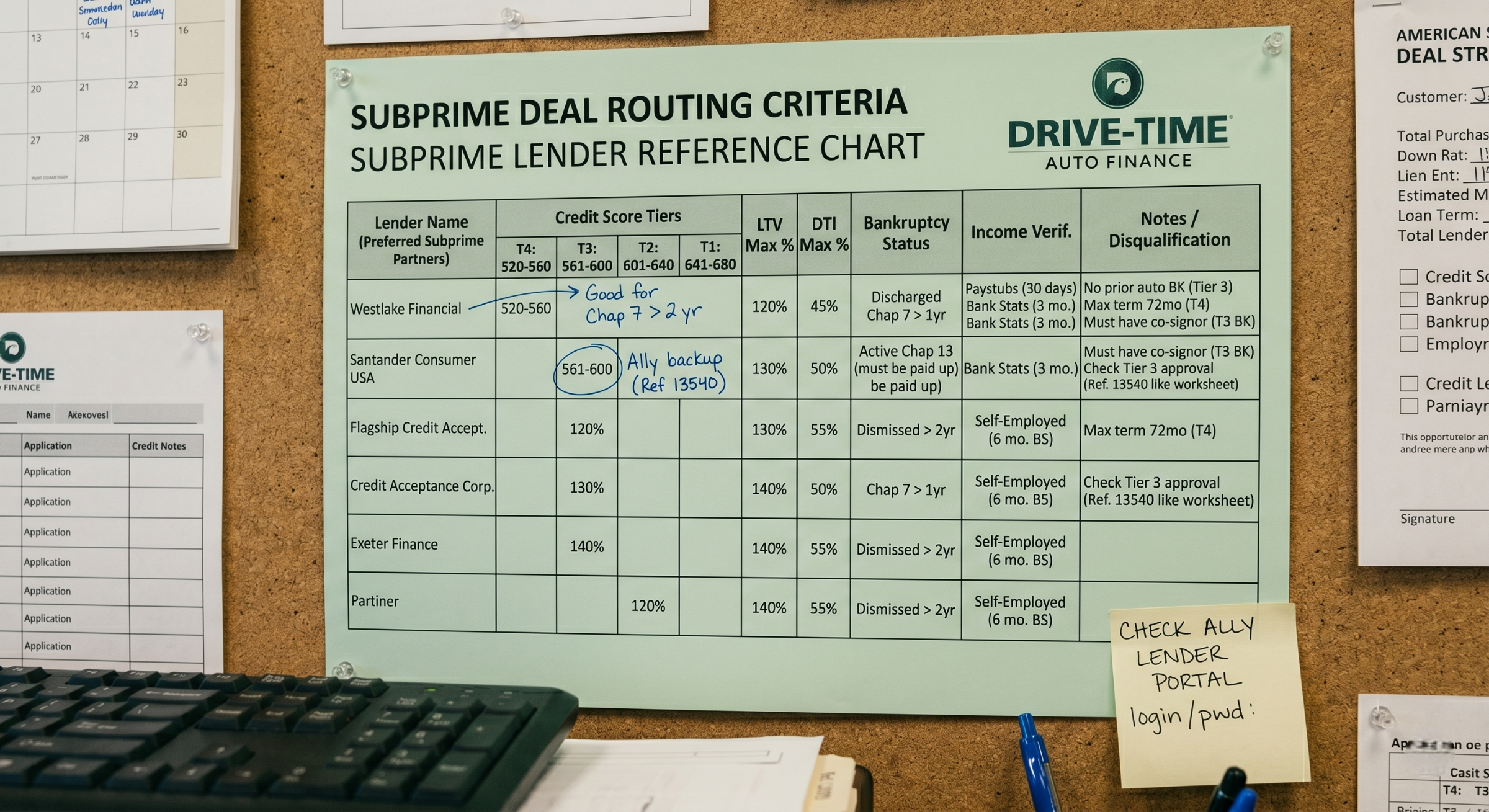
The goal is coverage across the full subprime spectrum without significant overlap between your lender relationships.

Think about your lender mix in terms of credit tiers. Which lender covers the 580 to 640 range best? Which one reaches into the 520 to 580 range? Which one handles deep subprime buyers below 520? Which one supplements with captive programs for near prime buyers on relevant manufacturer inventory?

When you map your lenders against the credit spectrum this way, the gaps become visible. A dealership with three lender relationships that all have minimum scores around 560 has strong coverage from 560 to 640 and weak coverage below 560. Identifying that gap tells you where the next lender relationship should focus.

The number of relationships matters less than the coverage they provide together. Two lenders with complementary credit tier appetite and different vehicle type strengths provide more useful coverage than three lenders who overlap significantly on criteria.

Building a subprime lender mix that covers the full credit spectrum is the structural work that determines how much of your subprime volume actually closes rather than walking out the door.

How to Develop Lender Relationships That Actually Perform

Having a lender relationship on paper and having one that works well in practice are different things. The quality of the relationship affects your first-attempt approval rate, your turnaround time, and how problems get resolved when they come up.

A few things that build strong lender relationships over time.

Submitting clean, well-structured deals. Lenders notice when dealers consistently submit deals that have been structured properly before submission. Clean first submissions build a reputation that sometimes results in more flexibility on edge cases and faster turnaround on straightforward approvals. The opposite is also true. A dealer who consistently submits poorly structured deals develops a reputation that can affect how their submissions are prioritized.

Communicating income and deal details accurately. Misrepresenting buyer income or deal details, even inadvertently, damages the lender relationship significantly. Accuracy in what you submit, even when it means acknowledging that a deal is marginal, builds more trust than optimistic submissions that fall apart at verification.

Staying current on their criteria. Lender criteria change. Following up regularly with your lender contacts to confirm that your routing knowledge is still accurate prevents routing errors that come from applying outdated information. A quarterly check-in with each lender relationship to review any changes to their criteria is a simple habit that pays for itself in routing accuracy.

Providing feedback on the buyer experience. Lenders who work with specific dealer partners over time appreciate feedback on how their products and processes are landing with buyers. A dealer who communicates constructively when something isn’t working creates a more collaborative relationship than one who simply routes volume without engagement.

What to Do When a Lender Relationship Isn’t Performing

Not every lender relationship works out. Some lenders promise flexibility during the sales conversation and deliver less of it in practice. Some change their criteria after you’ve built routing around them. Some have approval turnaround that consistently frustrates buyers and costs deals.

Evaluating lender performance quarterly using your tracked metrics is the right approach. First-attempt approval rate by lender, average turnaround time, and buyer feedback on the experience are the indicators that tell you whether a lender relationship is performing or just occupying a slot in your lineup.

A relationship that consistently underperforms against the alternatives in its tier deserves a direct conversation with your lender contact before you consider replacing it. Sometimes performance problems have specific causes that can be addressed. Sometimes the relationship has simply run its course and a better option for that tier is worth developing.

Replacing a lender relationship takes time because the new relationship needs to be developed to the point where you know their criteria in detail. Building the next relationship before you fully exit the old one is the pragmatic approach.

The Role of Lender Knowledge in Lead Conversion

There’s a direct connection between how well your team knows your lenders and how well they convert subprime leads.

A finance manager who can make a confident, accurate routing decision on the first call with a subprime buyer, rather than needing to check, call around, and get back to them, creates a completely different buyer experience. Confidence is contagious in this conversation. A buyer who’s uncertain about whether approval is possible responds to a finance manager who knows exactly which lender fits their profile and why.

That confidence comes from lender knowledge that’s genuinely internalized rather than just documented somewhere. Regular training on lender criteria, deal structure workshops that use real scenarios from your pipeline, and monthly review of routing decisions and their outcomes all contribute to building that internalized knowledge.

Investing in your team’s subprime lender knowledge is one of the highest-return training investments in a dealership subprime operation because it directly affects first-attempt approval rate and buyer experience simultaneously.

The Bottom Line

The best lenders for subprime auto financing at your dealership are the ones your team knows in detail, whose criteria match your buyer profile and vehicle inventory, and who cover the full credit spectrum your operation serves without significant gaps.

Building those relationships takes time and ongoing attention. Maintaining them requires staying current on criteria changes, submitting clean deals consistently, and evaluating performance regularly against your actual metrics.

The dealerships that consistently close subprime volume at strong rates are the ones who treat lender relationships as a strategic asset rather than a list of phone numbers to call when a deal needs a home. That distinction shows up in every approval rate comparison between operations in the same market with the same buyer profiles.

How Autocarleads Supports Dealer Lender Operations

Every subprime lead that comes through Autocarleads is credit range classified based on verified data, which means your team knows exactly which tier they’re working with from the first call and can route to the right lender without guessing.

Real-time delivery into your CRM, validated contact information, and geographic matching that reflects your actual service area give your lender relationships the lead quality they need to perform at their best.

See what subprime lead options are available in your market and how the matching works.

Frequently Asked Questions

How many lender relationships does a subprime operation need to be effective?

Two to three strong relationships with complementary credit tier coverage give you meaningful flexibility across most of the subprime range. The goal is coverage of the full spectrum you serve without significant overlap between lenders. More than four or five relationships starts to create complexity without proportional coverage benefit. The quality and depth of the relationships matters more than the number.

Both have a place depending on your market and volume. National lenders offer consistency across your full service area and often have more developed dealer support infrastructure. Regional lenders sometimes have more competitive rates within specific credit tiers in their operating markets and occasionally more flexibility on deal structure edge cases. A mix of national and regional relationships often produces better coverage than relying entirely on one category.

Start with a trial period of 60 to 90 days where you route a specific portion of your volume that fits their stated criteria to the new lender. Track first-attempt approval rate, turnaround time, and buyer experience feedback over that period. Compare it to your existing relationships serving the same tier. If the results support the claim the lender made during the relationship development conversation, scale the volume. If they don’t, you’ve learned something at manageable cost.

Your routing decisions immediately become potentially inaccurate. Build a process for receiving and incorporating criteria updates from your lenders as they occur. A quarterly check-in call with each lender contact is a simple way to surface changes before they produce routing errors. Lenders who communicate changes proactively to their dealer partners are worth noting. Those who don’t until you discover it through a decline pattern require more proactive monitoring.

It depends on your market and your operational appetite. Buy here pay here is a different business model with different capital requirements, portfolio management needs, and compliance considerations. For dealers where deep subprime volume is significant and the operational investment is feasible, it provides coverage that no external lender can match. For dealers where deep subprime is occasional volume rather than a core focus, referring to an established buy here pay here operator maintains the buyer relationship without the operational complexity of running the model internally.