
Auto Loan Lead Conversion Rates: Industry Benchmarks & Tips

Autocarleads | Updated April 2026 | 7 min read
Most dealerships track how many leads they buy. Far fewer track what actually happens to those leads after they arrive.
Conversion rate is the number that closes the gap between lead spend and actual revenue.
Without it, you’re flying blind on whether your lead budget is working or just getting spent.
This article covers what healthy conversion rates look like across the industry, how to measure yours accurately, and the specific things that move the number up when it’s not where it should be.
Why Conversion Rate Matters More Than Lead Volume
Lead volume tells you how busy your team is. Conversion rate tells you how effective they are.
A dealership buying 500 leads a month and converting at 5 percent closes 25 deals. A dealership buying 200 leads and converting at 15 percent closes 30 deals at less than half the lead spend.
The second dealership is doing more with less. That’s not luck. That’s a better process applied to better-matched leads.
Chasing volume without understanding your conversion rate is one of the most common and most expensive patterns in lead buying. More leads don’t fix a conversion problem. They just make it more expensive.
Industry Benchmarks: What the Numbers Actually Look Like
Conversion rates vary significantly based on lead type, follow-up process, credit profile, and geographic market. Here’s a realistic framework based on what the industry typically sees.
Overall lead-to-close rate
A well-run dealership working quality purchased leads can expect somewhere between 8 and 15 percent overall. Below 5 percent almost always signals a lead quality problem, a follow-up problem, or both. Above 15 percent typically reflects strong lead quality combined with a fast, well-executed process.
Contact rate
Of all leads purchased, a team with a fast follow-up process should reach 45 to 60 percent of buyers by phone or text. Below 35 percent is a red flag. Above 60 percent usually reflects a combination of excellent lead quality and a very fast response time.
Contact-to-appointment rate
Of the buyers you actually reach, a reasonable benchmark is 25 to 40 percent agreeing to move forward in some meaningful way, whether that’s booking an appointment, completing a credit application, or engaging in a substantive conversation about a vehicle.
Appointment-to-close rate
Of buyers who make it to an appointment or active conversation, somewhere between 40 and 60 percent typically result in a closed deal depending on inventory fit, financing options, and how the in-person or remote process is handled.
Exclusive versus shared leads
Exclusive leads convert at significantly higher rates than shared leads for the same credit profile and market. A dealership converting shared leads at 8 percent might convert exclusive leads from the same provider at 18 to 25 percent. The higher per-lead cost of exclusive leads often produces a lower cost per closed deal when conversion rates are factored in.
How to Calculate Your Actual Conversion Rate
Before you can improve your conversion rate, you need to know what it actually is. Here’s how to calculate it properly.
Take the total number of purchased leads received in a given period. Divide the number of closed deals that originated from purchased leads by that total. Multiply by 100 to get your percentage.
If you received 150 leads last month and closed 12 deals from those leads, your conversion rate is 8 percent.
Track this number separately for each lead source. A blended conversion rate across all sources hides the performance difference between them. One source might be converting at 18 percent while another sits at 3 percent. Knowing that tells you exactly where to put your budget next month.
Tracking auto loan lead conversion rates by source is one of the highest-return habits a dealership manager can build into their monthly process.
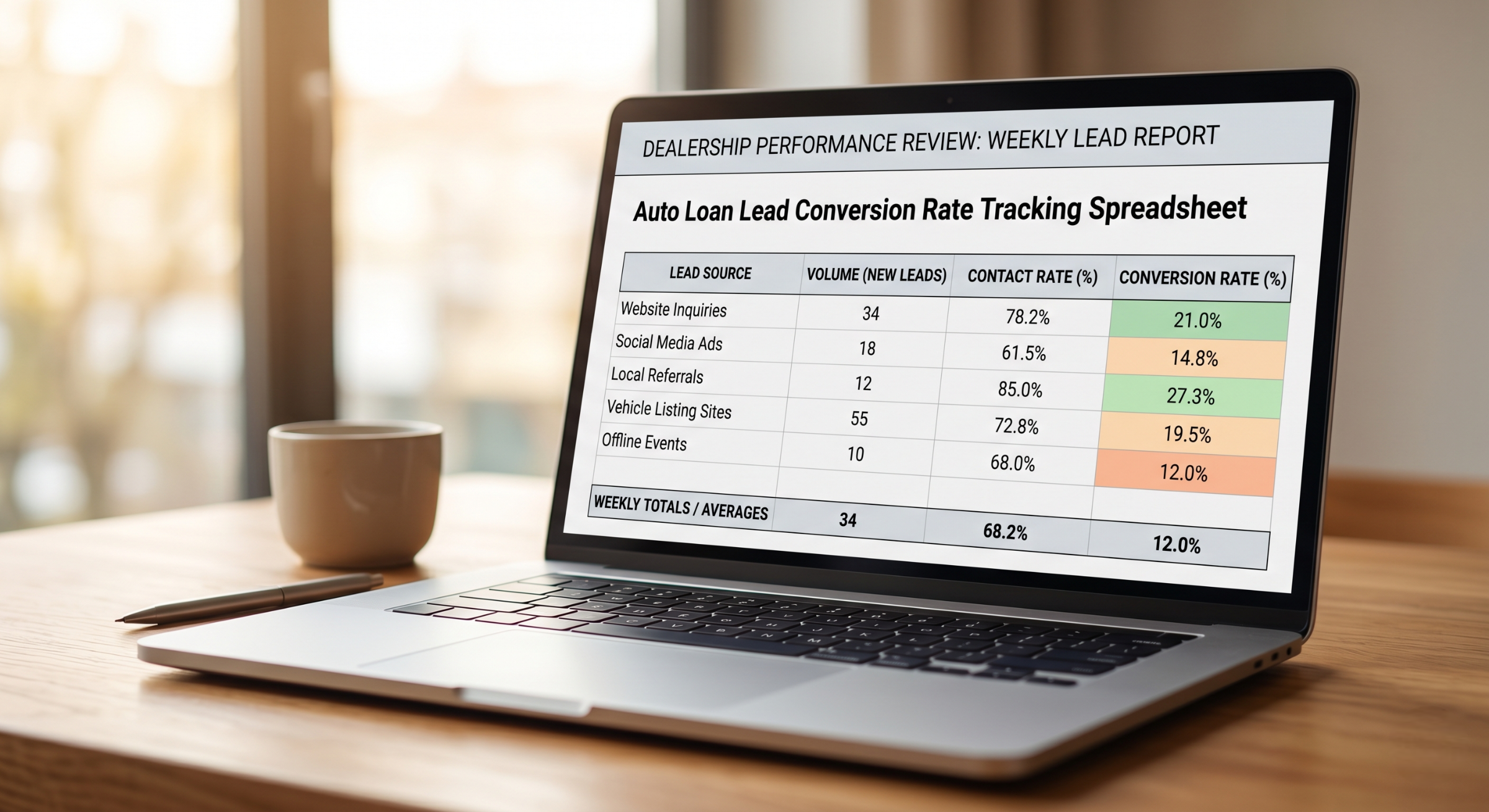
What Drives Conversion Rate Up or Down
Conversion rate is not a fixed number. It responds to specific inputs. Here’s what moves it most.
Response time
This is the single biggest variable in contact rate and ultimately in conversion rate. The research on this is consistent. Leads contacted within five minutes of submission convert at dramatically higher rates than leads contacted an hour later. Intent fades fast. A buyer who was actively thinking about financing when they submitted a form may have moved on by the time you call two hours later.
If your conversion rate is low, check your average response time before you look at anything else. It’s often the culprit.
Lead quality and matching
A lead that doesn’t fit your product or your market will not convert regardless of how good your follow-up is. A subprime lead sent to a prime lender, a buyer three states away, a contact with an unverified phone number. These aren’t follow-up problems. They’re lead quality problems.
Credit range filtering and geographic targeting reduce the volume of leads that were never going to convert in the first place. That directly improves your conversion rate even before your team makes a single call.
Number of contact attempts
Most buyers don’t answer the first call. Most sales teams stop trying after the second.
The gap between those two behaviors is where a significant portion of lead budget disappears every month. A structured multi-touch sequence across phone, text, and email over the first 48 to 72 hours consistently produces better results than one or two attempts followed by moving on.
If your contact rate is reasonable but your conversion rate is low, look at how many attempts your team makes before abandoning a lead.
Quality of the first conversation
Reaching a buyer is step one. What happens in that first 60 seconds determines whether the conversation goes anywhere.
A generic opener that could apply to any buyer signals immediately that you haven’t looked at their information. A specific, relevant opening that references what they were looking for creates a completely different dynamic.
Know who you’re calling before you dial. Use the information in the lead to make the conversation feel personal rather than transactional. That shift in approach affects appointment rate more than almost anything else.
Financing options available
A buyer who’s ready to move but whose credit profile doesn’t match your available financing goes nowhere regardless of how well the conversation went. Making sure your lender options cover the range of credit profiles your leads represent is a product fit issue worth reviewing regularly.
Where Most Dealerships Lose Leads in the Funnel
Running through the numbers on where leads are dropping out tells you exactly where to focus.
If your contact rate is low, the problem is either lead quality, specifically bad contact information or poor geographic match, or response time. Fix one or both.
If your contact rate is solid but your contact-to-appointment rate is low, the opening conversation needs work. The leads are real buyers but something in the approach is losing them before they commit to a next step.
If your appointment rate is reasonable but deals aren’t closing, the issue is happening at the dealership level. Inventory fit, financing options, or the in-person sales process. Buying more leads doesn’t fix any of those.
If your closing rate from appointments is strong but your overall conversion rate is low, you’re losing too many leads before they get to an appointment. Go back to contact rate and follow-up sequence.
Work through the funnel from top to bottom and fix the biggest leak before you try to fix anything else.
Practical Tips for Improving Your Conversion Rate
A few specific actions worth implementing if your numbers aren’t where you want them.
Set a five-minute response time standard during business hours and enforce it. Measure actual response times in your CRM every week. If the average is above 15 minutes, that’s the first thing to fix.
Build a minimum five-touch follow-up sequence for every lead. Call, text, email across the first 48 to 72 hours. Log every attempt. Move unresponsive leads to a longer-term nurture sequence rather than abandoning them entirely.
Personalize the opening of every call with something specific to that buyer’s inquiry. Vehicle type, financing situation, location. Anything that signals you actually read their information before you called.
Review your filter settings quarterly. If your contact rate is slipping, your lead targeting may need adjustment. Credit range or geographic filters that made sense three months ago may not be optimized for your current market conditions.
Track conversion rate by lead source every single month. Let the data tell you where to put next month’s budget rather than relying on habit or relationships with providers.
Improving auto loan lead conversion rates consistently over time is more valuable than chasing volume. A five percentage point improvement in conversion rate on 200 leads a month is 10 additional closed deals without spending another dollar on leads.
The Relationship Between Lead Quality and Conversion Rate
These two things are more connected than most dealerships treat them.
A team working low-quality leads will have a low conversion rate and assume their process is the problem. A team working high-quality leads will have a better conversion rate and assume their process is the reason. Neither conclusion is fully accurate.
The honest picture is that lead quality creates a ceiling on what your process can achieve. The best follow-up in the world won’t turn a fake phone number into a deal. But a strong process applied to quality leads produces results well above what the same leads would produce with a weak process.
Both variables matter. Fixing one without addressing the other produces limited improvement. The dealerships that consistently outperform on conversion rate are the ones who take both seriously at the same time.
The Bottom Line
Conversion rate is the number that tells you whether your lead buying is actually working.
Track it by source. Understand where in the funnel you’re losing leads. Fix the biggest leak before you address anything else. And resist the instinct to solve a conversion problem by buying more leads.
More leads amplify whatever process you already have. A strong process converts well. A weak one converts poorly, just at higher volume and higher cost.
The work is in the process. The leads just give you something to apply it to.
How Autocarleads Supports Better Conversion Rates
Every lead that comes through Autocarleads is pre-screened, intent-verified, and matched to your market before delivery. Real-time delivery, validated contact information, and filtering options that align leads to your product and geography.
Better matched leads convert at higher rates. That’s not a marketing claim. It’s the math of lead buying applied to leads that were worth buying in the first place.
See what’s available in your area and how the matching works.
Frequently Asked Questions
What is a good auto loan lead conversion rate for a dealership?
Between 8 and 15 percent is a reasonable benchmark for a well-run operation working quality purchased leads. Below 5 percent almost always indicates a lead quality or follow-up process issue worth investigating. Above 15 percent typically reflects both strong lead quality and a fast, well-executed follow-up system. Track your rate by source rather than as a single blended number to get the most useful picture.
Why is my conversion rate lower for shared leads than exclusive leads?
Shared leads go to multiple dealerships simultaneously. By the time you reach a buyer, they may have already spoken to competitors. The receptiveness is different and the conversation is harder to start from a position of advantage. Exclusive leads give you a first and only shot at the buyer, which changes the dynamic of the conversation significantly. The higher per-lead cost of exclusive leads often produces a lower cost per closed deal once conversion rates are factored in.
How many contact attempts should we make before moving a lead to a nurture sequence?
Most industry data points to five to eight attempts across phone, text, and email within the first 72 hours as the standard before moving to a longer-term nurture sequence. One or two attempts is one of the most consistently expensive habits a dealership can have. A meaningful percentage of leads that eventually convert do so on the third, fourth, or fifth contact attempt.
Can improving my follow-up process really move the conversion rate that much?
Yes, significantly. Response time alone can double or more than double your contact rate, and contact rate is the foundation of everything else in the conversion funnel. A team moving from a 90-minute average response time to a five-minute standard typically sees immediate and meaningful improvement in contact rate and downstream conversion without changing anything else about the process.
Should I adjust my lead filters if my conversion rate drops?
It’s one of the first things worth checking. A drop in conversion rate that coincides with a change in lead volume or source often reflects a mismatch between what you’re buying and what your product can serve. Review your credit range and geographic filter settings to make sure they still align with your actual market and financing options. Filters that were well-calibrated six months ago may need adjustment as your market or product mix evolves.