
TL;DR — Quick Summary
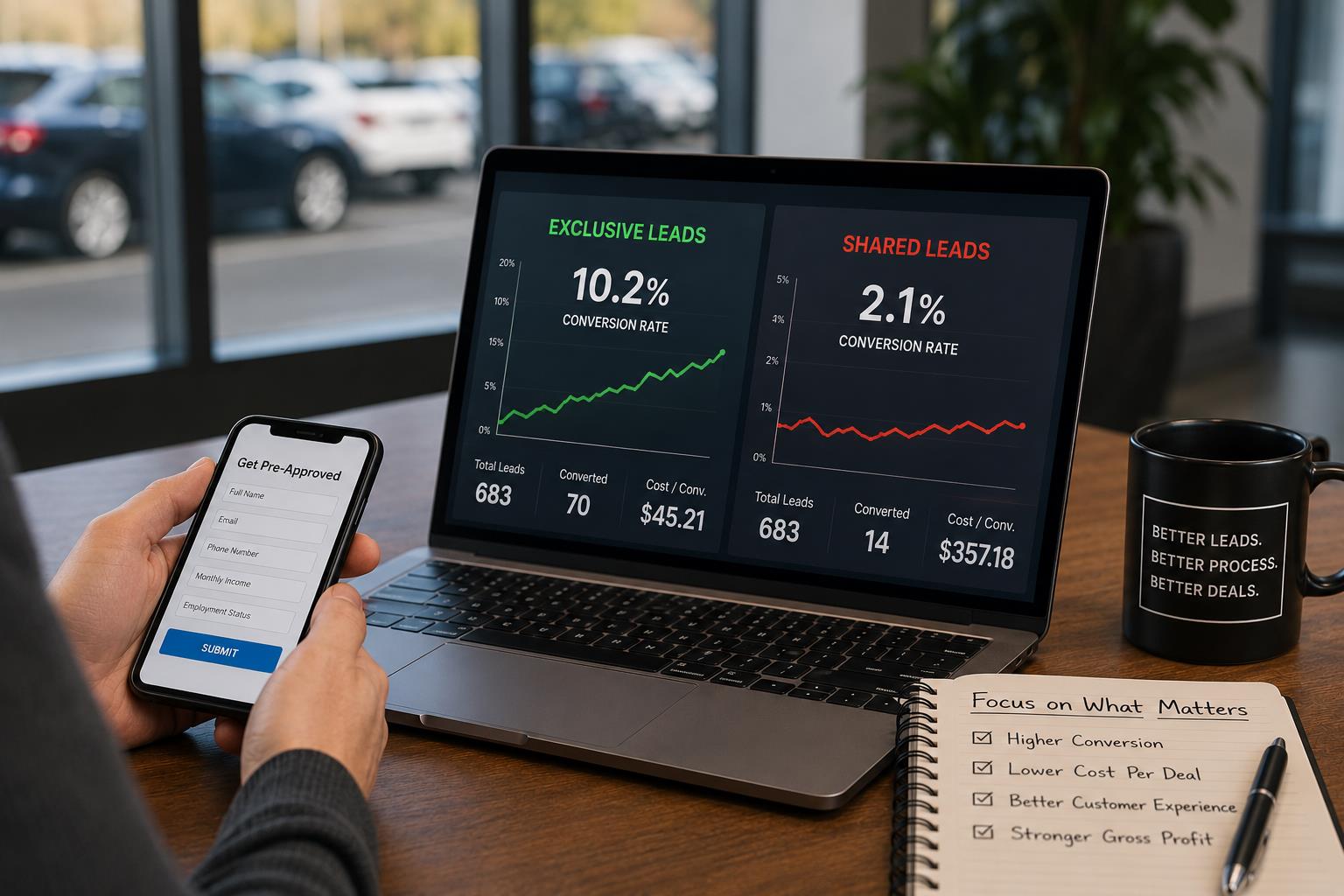
- Exclusive auto leads convert at 6–15% in Canadian dealerships, while shared leads typically close at 1–3% because the buyer is contacted by 3–5 competitors simultaneously.
- Shared leads cost less per lead but produce a higher effective cost-per-funded-deal once close rates and BDC labour are factored in.
- Speed-to-lead matters far more on shared leads, where the first dealership to call wins roughly 50% of the time — but exclusive leads remove that race entirely.
- Exclusive leads protect gross profit because buyers haven’t been pre-shopped, anchored on competitor pricing, or burned out on follow-up calls.
- Autocarleads delivers 100% exclusive, pre-screened Canadian auto finance leads with income verification and AI-powered SMS follow-up within 5 minutes.
A subprime buyer fills out a finance application at 8:47 PM. By 8:52 PM, four dealerships have her phone number. By 9:15 PM, she’s received seven calls and four texts. By morning, she’s stopped answering. That’s the shared-lead economy — and it’s why most dealers chasing cheap leads end up with a CRM full of cold contacts and a BDC team that’s burning out.
The exclusive vs shared auto leads debate isn’t really about cost per lead. It’s about cost per funded deal, customer experience, and whether your team is selling cars or playing telephone tag with buyers who’ve already talked to three of your competitors. Here’s what the numbers actually say.
AUTOCARLEADS
Tired of competing with four other dealers on every lead?
See how exclusive, pre-screened Canadian auto finance leads change the math on close rates and BDC efficiency. No long-term contract required.
What’s the Real Difference Between Exclusive and Shared Auto Leads?
An exclusive auto lead is sold to one dealership only. A shared lead is sold to 3–5 dealerships at the same time, all of whom receive the buyer’s contact details within seconds of submission. That single distinction changes everything downstream — close rates, gross profit, BDC workload, and buyer experience.
Most shared-lead providers operate on volume. They sell the same application to multiple dealers because that’s how the unit economics work at $8–$25 per lead. The lead-gen company gets paid 3–5 times; the buyer gets called 3–5 times; and your dealership gets one of however-many shots at a buyer who is now exhausted, suspicious, or already pre-committed to whoever called first.
Exclusive leads cost more per unit — typically 2–4× the price of a shared lead — but the buyer hasn’t been touched by anyone else. When your BDC calls, the conversation starts at zero, not at “Yes, I’ve already talked to four people today.” That’s the entire value proposition, and it’s worth understanding before evaluating any provider. Here’s how exclusive auto finance leads work in practice from intake to delivery.
Close Rate Comparison: Exclusive vs Shared Auto Leads
Exclusive auto finance leads consistently close at 6–15% across Canadian dealerships, while shared leads typically close at 1–3% — a 3–5× difference that survives across credit tiers, vehicle types, and provincial markets. The gap exists because exclusive buyers don’t have competitor pricing in their inbox before your sales manager picks up the phone.
| Metric | Exclusive Leads | Shared Leads |
|---|---|---|
| Typical close rate | 6–15% | 1–3% |
| Cost per lead | $30–$75 | $8–$25 |
| Contacted by competitors | No | Yes (3–5 dealers) |
| Speed-to-lead pressure | Standard (5-min ideal) | Extreme (seconds matter) |
| Avg gross per deal | Protected | Compressed by competitor quotes |
The 6–15% range on exclusive leads tracks with what Autocarleads sees across its 150+ Canadian dealership clients, including both prime and subprime portfolios. Dealerships with mature BDC processes and 5-minute call-back discipline trend toward the top of that range; newer teams sit closer to the bottom — but even 6% on exclusive crushes 3% on shared once you factor in the labour cost of working the lead.
“Dealerships that follow up within 5 minutes of a lead submission are 9× more likely to connect with the buyer than those who wait 30 minutes.” — MIT Lead Response Management Study
The True Cost Per Funded Deal: Why “Cheaper” Leads Aren’t
A $15 shared lead at a 2% close rate produces a cost-per-funded-deal of $750. A $45 exclusive lead at a 10% close rate produces a cost-per-funded-deal of $450. The exclusive lead is 3× more expensive on the surface and 40% cheaper in reality — before you add BDC time, manager touches, and the opportunity cost of cold contacts clogging your CRM.
This is the math most dealerships get wrong when they start comparing cost per lead versus lead ROI. The headline price on a shared lead looks unbeatable. The fully-loaded cost — including BDC hours spent on contacts who never answer because they’re avoiding four other dealers — tells a different story.
There’s also a gross profit dimension. Shared buyers shop. By the time they walk in, they’ve usually been quoted by competitors and anchored on a price or payment. Exclusive buyers — especially subprime applicants who care about approval more than rate-shopping — leave more room for backend product attachment and a healthier front-end gross.
⚠️ Shared Lead Alert: If a lead provider won’t tell you exactly how many dealerships receive the same application, assume the worst. Industry-standard shared distribution is 3–5 dealers per lead, and some platforms push to 7–10. Always ask for the distribution count in writing before you sign.
AUTOCARLEADS
Canadian Dealerships Close 6–15% of Autocarleads Inbound Leads — Because They’re 100% Exclusive.
Every applicant is pre-screened with verified $1,800+ monthly income and delivered to one dealership only. We geo-target by territory so you’re never competing against a partner store across town.
Speed-to-Lead: Why It Matters More on Shared Leads
On shared auto leads, the first dealership to call connects roughly 50% of the time — and the second dealership’s connect rate falls off a cliff within 10 minutes. On exclusive leads, the 5-minute speed-to-lead window still matters for buyer engagement, but you’re not racing competitors, you’re racing the buyer’s attention span.
This is where the structural advantage of live transfers and real-time delivery shows up. An exclusive live transfer puts a verified buyer on the line with your finance team while their intent is hottest — no ping-pong with three other dealers, no callback voicemail, no day-three follow-up trying to revive a cold lead.
A BDC team running shared leads needs to be aggressive, fast, and always-on, or the lead is dead. A BDC team running exclusive leads can focus on quality conversations — which is also when reps stop quitting. Burnout from chasing dead shared leads is one of the quietest drivers of turnover in dealer BDC operations across Ontario, Alberta, and BC.
When Shared Leads Still Make Sense (And When They Don’t)
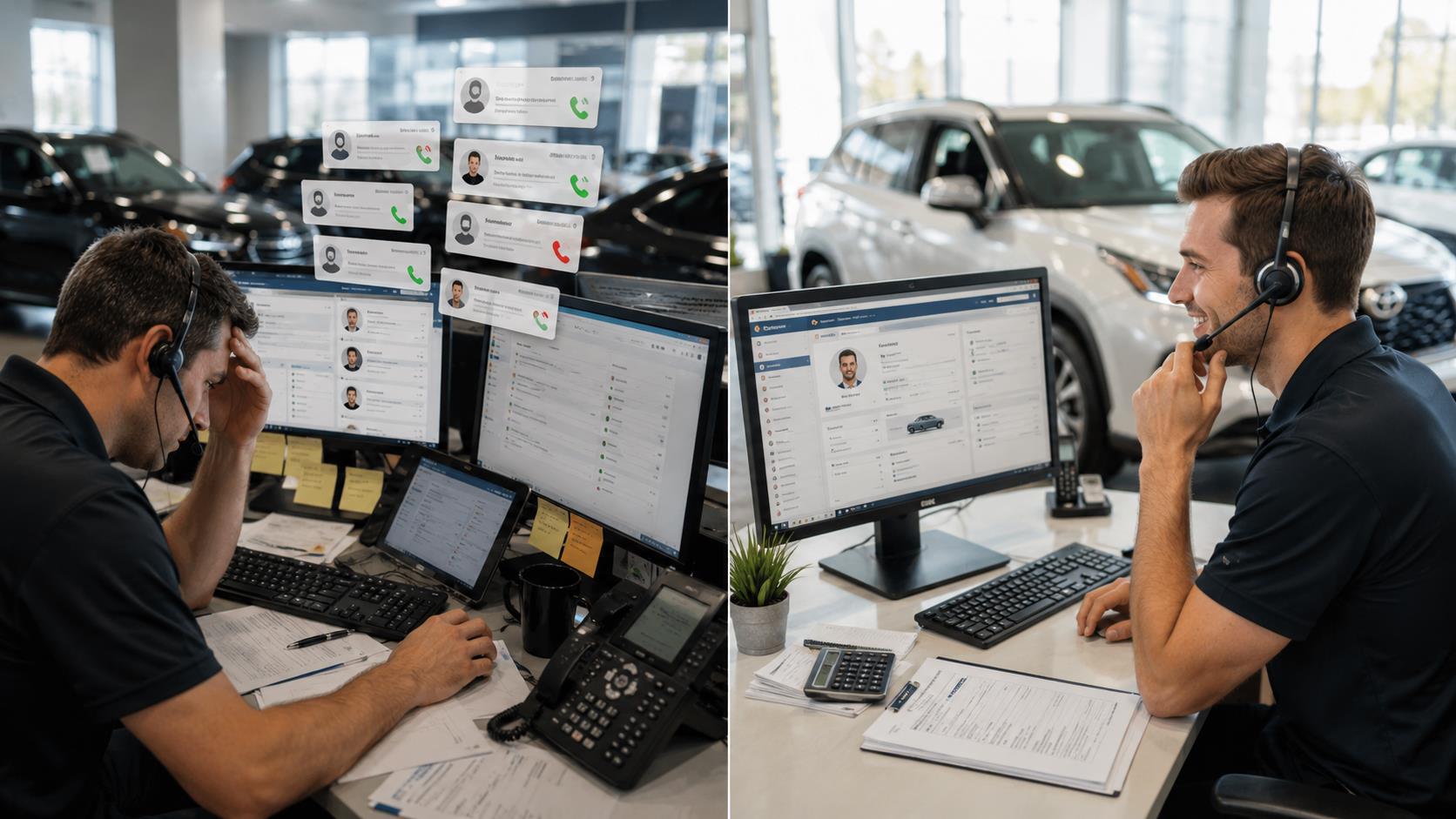
Shared auto leads can make sense for high-volume independent stores with mature, fast BDC operations and prime-credit inventory at sharp pricing — situations where winning on speed and price is realistic. They rarely make sense for subprime portfolios, smaller BDC teams, or any dealership trying to protect gross.
For most Canadian dealerships, especially those working subprime and bad credit buyers, exclusive leads are the more defensible buy. Subprime customers are emotionally fragile about approval. Getting called by five dealers makes them suspicious and pushes them off-market entirely. Getting called by one dealership that’s been pre-screened against their income profile keeps them engaged.
There’s also the question of provider trust. With shared leads, the provider’s incentive is to sell each lead as many times as possible. With exclusive leads, the provider’s incentive is lead quality, because they only get paid once — and a buyback or replacement guarantee is meaningful. Reviewing the provider’s pre-screening and QA process matters more than the headline price.
How to Audit Your Current Lead Mix in 15 Minutes
Pull last quarter’s CRM data and run cost-per-funded-deal by lead source — not cost per lead. That single calculation usually reframes the entire conversation about which provider is actually profitable.
- Export 90 days of leads by source, including spend.
- Match to funded deals by source.
- Divide source spend by funded deals — that’s true CPA.
- Layer in average front-end gross per source.
- Calculate gross margin per dollar spent by source.
- Rank sources. Cut the bottom 30%. Reinvest in the top 30%.
Most dealerships that run this audit discover that their cheapest lead source is also their most expensive funded-deal source — and that scaling exclusive volume in protected territories produces better unit economics than chasing cheaper shared inventory. Autocarleads structures territory exclusivity around dealer geography, so the math holds even as you scale. Compare other provider models on the Autocarleads dealer growth blog before committing to a long contract elsewhere.
Frequently Asked Questions
What is the difference between exclusive and shared auto leads?
Exclusive auto leads are sold to one dealership only, while shared auto leads are sold to 3–5 dealerships simultaneously. That distinction directly drives close rates: exclusive leads convert at 6–15% in Canada while shared leads convert at 1–3% because buyers are being contacted by multiple competing dealers at the same time.
Are exclusive auto leads worth the higher price?
Yes, exclusive auto leads are typically worth the higher price because cost-per-funded-deal is what matters, not cost-per-lead. A $45 exclusive lead closing at 10% costs $450 per deal, while a $15 shared lead closing at 2% costs $750 per deal — and that’s before factoring in BDC labour, compressed gross profit, and the opportunity cost of cold contacts.
How many dealers receive a typical shared auto lead?
A typical shared auto lead is sold to 3–5 dealerships, though some providers distribute the same application to 7–10 dealers. Always ask the provider for the distribution count in writing before signing a contract — if they refuse to disclose it, that’s a signal the number is higher than they want you to know.
Do shared leads work for subprime auto financing?
Shared leads generally underperform for subprime auto financing because subprime buyers are emotionally sensitive to multiple dealer calls and tend to disengage when they feel overwhelmed. Exclusive leads work better in subprime because the single calling dealership can build trust, walk the buyer through the approval process, and protect the deal.
How fast does a dealership need to respond to an exclusive lead?
A dealership should respond to an exclusive auto lead within 5 minutes to maximize contact rates, based on MIT lead response research showing a 9× higher connect probability inside that window. Autocarleads supports this with AI-powered SMS follow-up that engages the buyer within 5 minutes of submission, even before the dealer’s BDC team calls.
Can a dealership mix exclusive and shared auto leads in the same strategy?
Yes, many Canadian dealerships run a mixed strategy where exclusive leads anchor the subprime and high-intent volume while shared leads supplement prime-credit volume during inventory pushes. The key is measuring cost-per-funded-deal by source separately, because lumping the two together hides which channel is actually profitable.
Ready to Stop Splitting Leads With Your Competitors?
Autocarleads connects Canadian dealerships with exclusive, pre-screened car loan leads — including subprime buyers — delivered in real time with AI-powered SMS follow-up. Every applicant is income-verified before they reach your team.
- ✅ 100% exclusive leads — never shared
- ✅ Lead buyback guarantee
- ✅ No long-term contracts
- ✅ Geo-targeted to your territory
📍 Address: Serving dealerships across all Canadian provinces
📞 Phone: +1-888-510-0264
🌐 Website: Schedule your free consultation at autocarleads.ca
Selling cars is hard enough. Let Autocarleads bring the buyers to you.