
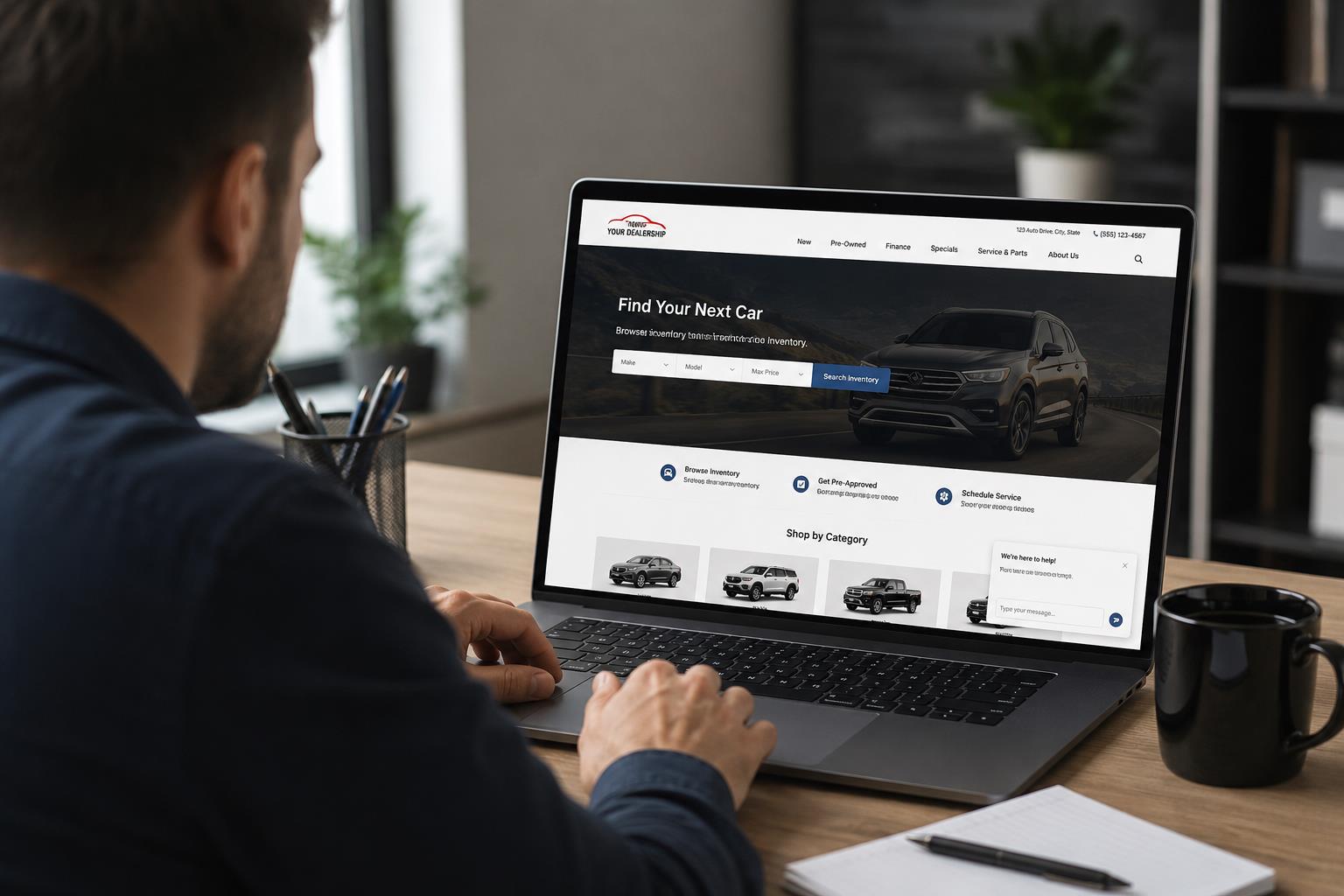
Your dealership website is open 24 hours a day, seven days a week. No BDC agent, no showroom staff, no follow-up calls needed — it’s always there, always ready to take a lead. The problem most Canadian dealers run into isn’t traffic. It’s conversion. Thousands of potential buyers land on dealership websites every month and leave without submitting a single form, clicking a single phone number, or booking a single appointment. If your site isn’t built to capture leads, it’s built to lose them.
This guide walks through the practical changes that turn a passive dealership website into an active lead generation asset — from form design and page structure to the digital handoff that gets buyers into your CRM and your finance office.
TL;DR
- Most dealership websites generate far fewer leads than they should because conversion paths are buried, broken, or missing entirely.
- Short, frictionless lead capture forms outperform long applications — especially for credit-challenged buyers who hesitate at hard credit pull language.
- Finance and “get approved” pages are your highest-converting real estate — treat them like landing pages, not afterthoughts.
- Speed-to-lead is the single biggest factor in whether an online inquiry converts — follow up within five minutes or lose the buyer.
- Want to supplement your website leads with exclusive, pre-screened Canadian auto finance leads? Call Autocarleads at +1-888-510-0264.
AUTOCARLEADS
Not Enough Leads Coming Through Your Website?
Autocarleads supplies 150+ Canadian dealerships with exclusive, pre-screened auto finance leads — so your pipeline never depends on web traffic alone.
Why Most Dealership Websites Leak Leads
Before fixing anything, it helps to understand where the breakdown actually happens. Most dealership websites don’t have a traffic problem — they have a conversion problem. A buyer lands on your inventory page, browses three or four listings, then leaves. No form submitted. No call made. No appointment booked. That buyer didn’t go away; they went to a competitor who made it easier to take the next step.
The most common culprits are friction and trust. Friction shows up as forms that ask for too much information before a buyer is ready to commit — full credit applications with SSN fields, monthly income breakdowns, and employment history on page one. Trust erodes when the finance page is thin, the “Apply Now” button leads to a generic third-party portal, or there’s no clear signal that the dealership actually handles all credit situations.
Credit-challenged buyers — a segment that represents a significant share of the Canadian auto finance market — are especially likely to abandon a complicated form. They’re already uncertain about approval. Add a long application and hard-pull language, and you’ve lost them before the conversation even starts. The fix isn’t to lower your standards; it’s to lower the perceived risk of starting the process.
Inconsistency also costs dealers leads. A buyer who finds your inventory page through Google and clicks “Finance This Vehicle” should land on a page that feels connected — same branding, same tone, a clear next step. If they land on a blank form with no context, they bounce. Cohesive conversion paths are something many independent Canadian dealers still haven’t built, and it’s one of the clearest competitive gaps in the market.
Build a Finance Page That Actually Converts
Your finance page is the most important lead-capture real estate on your entire website. This is where buyers who are actively thinking about buying go when they’re ready to raise their hand. Treat it like a landing page, not a section in a navigation menu.
A high-converting dealer finance page does a few things consistently. It opens with a clear, reassuring headline — something that tells the buyer they’re in the right place regardless of their credit history. “All Credit Situations Welcome” or “Get Approved Today — New and Returning Credit” sets the tone immediately. Follow that with two or three short paragraphs explaining your process in plain language: how the application works, what happens next, and how quickly they’ll hear back.
The lead capture form on this page should be short. Name, phone number, email, and the vehicle they’re interested in is enough to start a conversation. You can gather more detail in the follow-up call. A four-field form will always outperform a twelve-field application when your goal is generating the initial inquiry. Save the full credit app for the finance office or the second touchpoint.
Social proof belongs here too. A few lines from past buyers — especially buyers who were nervous about their credit — go a long way. If your DMS can pull verified reviews, even better. Buyers who see that someone with a situation like theirs got approved are far more likely to submit a form than buyers who are reading generic copy and guessing whether your dealership can help them.
💡 DID YOU KNOW:
According to a report by the Canadian Lenders Association, nearly 1 in 3 Canadians has a credit score below 660 — a threshold that often limits access to traditional auto financing. Dealers with visible, accessible bad credit and subprime financing messaging on their websites capture a disproportionate share of this underserved segment.
Source: Canadian Lenders Association, 2023, cloanada.com.
Optimize Your Inventory Pages for Lead Capture
Most buyers spend the majority of their time on inventory pages. They’re comparing makes, models, years, and prices — and they’re doing it before they’ve committed to your dealership. That means your inventory pages aren’t just a browsing experience; they’re a lead capture opportunity that most dealers underuse.
Every vehicle listing should have at least two clear calls to action: one to book a test drive and one to apply for financing. Don’t make buyers navigate away from the listing to take action. An embedded short form — just name, phone, and a note about which vehicle they’re interested in — converts far better than a “Contact Us” link that opens your general contact page.
Pricing transparency also affects lead volume. Buyers who can’t get a clear sense of what a vehicle costs tend to leave rather than call. If you post prices, post them clearly. If your pricing is flexible based on trade-in and financing, say so — and give buyers a way to start that conversation right on the listing page.
Vehicle detail pages (VDPs) for your highest-demand inventory deserve individual attention. If a specific truck configuration or certified pre-owned segment drives a disproportionate share of your traffic, those pages should have stronger lead capture elements — possibly including a limited availability notice, a featured financing offer, or a direct line to your finance manager rather than a generic form submit.
AUTOCARLEADS
Your Website Can’t Be Your Only Lead Source
Autocarleads sends Canadian dealerships exclusive, pre-screened auto finance leads with verified income — buyers who are actively looking for financing right now, not just browsing your inventory.
- ✓ 100% exclusive — your leads, never shared with another dealer
- ✓ Minimum $1,800/month income verified by our QA team
- ✓ AI-powered SMS follow-up within 5 minutes of inquiry
Book a Call With Phil or Steph
Or call +1-888-510-0264
Speed-to-Lead: The Variable Most Dealers Ignore
Form optimization and page design matter, but the single biggest variable in whether an online lead converts is how fast you respond to it. Studies from both the U.S. and Canadian auto markets consistently show the same pattern: response time within five minutes produces drastically higher contact and conversion rates than response times of thirty minutes or more. A buyer who just submitted a form on your website is thinking about their purchase right now. Call in five minutes and you’re the first voice they hear. Call in three hours and you’re competing with two or three other dealers who already had the same conversation.
The challenge for most dealerships is that form submissions don’t always trigger an immediate, human response. They route to an email inbox, get picked up by whoever checks it next, and by the time a follow-up goes out, the buyer has moved on. If your dealership doesn’t have a defined speed-to-lead process — someone whose job it is to respond to web inquiries within minutes — you’re paying for web traffic and giving the sale away.
At minimum, auto-responses matter. An immediate text or email confirming receipt and setting expectations (“We’ll call you within the next 15 minutes”) keeps the buyer engaged and signals professionalism. Better still is a system that routes new form submissions directly to a BDC agent or an on-duty F&I manager who can make live contact immediately. Some Canadian dealerships are also using AI-powered SMS tools to initiate the first touchpoint — a brief, personalized message that acknowledges the inquiry and opens the conversation — within seconds of the form being submitted.
“The dealership that calls first doesn’t always win — but the dealership that calls last almost always loses.”
Use Live Chat and Exit-Intent Tools Strategically
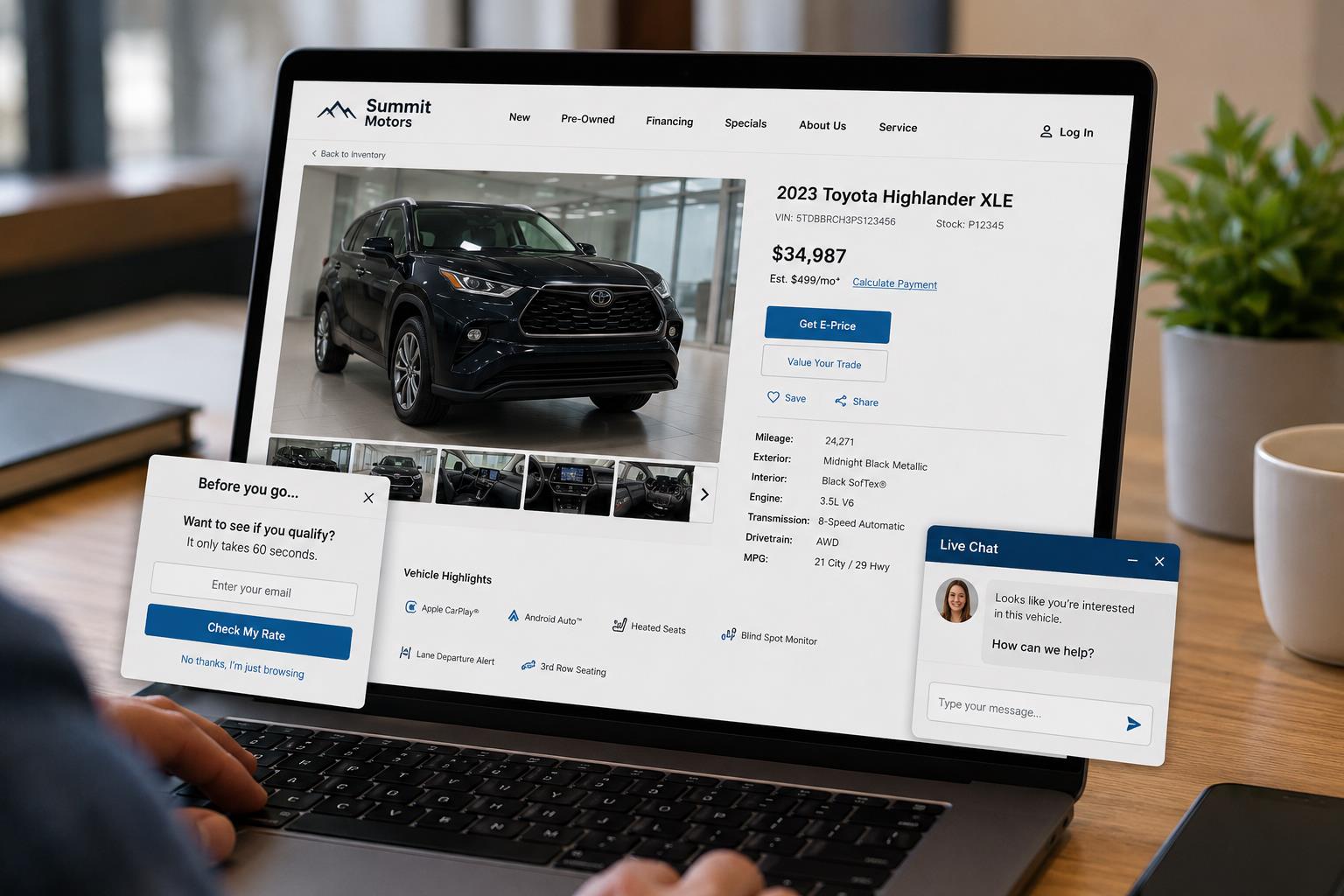
Not every buyer who visits your website is ready to submit a form. Some are early in the research phase and just want a quick question answered. Others are comparison shopping and haven’t committed to a make or model yet. Live chat lets you engage these buyers in a lower-stakes way — and often convert them into leads before they leave.
The key word is strategically. A chat widget that pops up with “Hi! Can I help you?” thirty seconds after someone lands on your homepage adds friction, not value. A chat prompt that appears on a specific inventory page after a buyer has been scrolling for ninety seconds — “Looking for financing options on this vehicle? Chat with us now” — is contextual and useful.
Exit-intent popups work similarly. When a buyer’s cursor moves toward the close button, a lightweight popup can capture an email address or phone number with a simple offer — “Before you go, want to see if you qualify? Takes 60 seconds.” This isn’t aggressive sales tactics; it’s giving the buyer one more chance to raise their hand before they leave your site entirely.
Both of these tools require restraint. Used well, they recover leads that would otherwise walk. Used poorly, they irritate buyers who were almost ready to convert. Test, monitor bounce rates and chat engagement, and adjust based on what your traffic data actually shows.
Connect Your Website to a CRM That Works
A lead that enters your CRM immediately is a lead you can manage. A lead that sits in an email inbox is a lead you’re already losing. Every form on your dealership website should feed directly into a CRM system that assigns ownership, logs the timestamp, and triggers the first follow-up step automatically.
Most Canadian dealerships are running one of a handful of automotive CRM platforms — Dealer Socket, VinSolutions, Reynolds and Reynolds, or similar. If your website forms aren’t integrated with your CRM, that’s the first technical fix to make, full stop. The integration doesn’t need to be complex. Name, phone, email, vehicle interest, and source (which page the form came from) is enough to route the lead to the right person and start the right conversation.
Source tracking matters more than most dealers realize. Knowing that a specific lead came from your finance page versus a VDP versus a paid search landing page tells you which parts of your website are producing and which parts need work. Over time, that data guides where you invest in CRO (conversion rate optimization), whether that’s testing a new form layout, adding a social proof block, or restructuring a page that’s getting traffic but not generating leads.
|
150+
Canadian dealerships served by Autocarleads
|
180,000+
Auto finance applications processed
|
6–15%
Average dealer conversion rate on leads
|
Pair Website Optimization With a Consistent Lead Supply
Optimizing your website is essential, but it’s a long game. SEO rankings take months to build. Paid traffic requires budget and ongoing management. Organic form conversions depend on the volume and quality of visitors who find you first. For dealerships that need a reliable, predictable lead stream right now — not six months from now — the most practical approach is pairing website improvements with an external lead source that fills the pipeline while the site work matures.
That’s where a service like Autocarleads becomes a complement to, not a replacement for, your website strategy. Dealerships across Canada use Autocarleads to receive exclusive, pre-screened auto finance leads — buyers with verified income who have already expressed intent to purchase and finance a vehicle. These leads aren’t recycled across multiple dealers. They’re geo-targeted to your territory, QA-screened before delivery, and followed up with AI-powered SMS within five minutes of submission.
The combination works because both channels reinforce each other. Your website builds brand recognition and handles the buyers who come to you directly. Autocarleads fills the gaps with buyers who are actively in-market but haven’t found your dealership yet. Together, they give your finance office a consistent flow of qualified conversations — which is the only metric that actually drives sold units at the end of the month.
Key Takeaways
- Audit your finance page first — it’s your highest-converting real estate and the most commonly neglected page on a dealer website.
- Shorten your lead forms to four fields or fewer; save the full credit app for the follow-up conversation, not the first touchpoint.
- Build a speed-to-lead protocol: define who responds to web inquiries, set a five-minute target, and use automated SMS to bridge the gap.
- Integrate all website forms with your CRM and track lead source so you know which pages are generating results.
- Supplement your website lead flow with an exclusive lead partner to keep your pipeline full while organic efforts compound.
Frequently Asked Questions
What should a dealership lead capture form include?
Keep it short: name, phone number, email address, and the vehicle or financing type the buyer is interested in. That’s enough to start a productive conversation. Asking for a full credit application, employment history, or income details at the first touchpoint creates friction and lowers form completion rates significantly. Save the detailed information gathering for the follow-up call or in-person appointment.
How many leads should a dealership website generate per month?
It varies by traffic volume, market size, and how well-optimized the site is, but a general benchmark is a 2–5% conversion rate on unique monthly visitors. A site receiving 3,000 visitors a month should be generating 60–150 leads in a well-optimized state. If you’re seeing rates below 1%, there’s almost certainly a friction issue on your finance page, your forms, or your calls to action.
What is speed-to-lead and why does it matter for dealerships?
Speed-to-lead is the time between when a buyer submits a form and when your dealership makes first contact. The shorter that window, the higher the probability of reaching the buyer and converting the inquiry into an appointment. Research consistently shows that contact rates drop sharply after the first five minutes. A buyer who submitted a form and didn’t hear back within an hour has almost certainly moved on to another dealership or lost interest.
Should Canadian dealerships use live chat on their websites?
Yes, but only if it’s staffed or automated in a way that actually responds quickly. A live chat widget that shows as “offline” or takes twenty minutes to respond does more harm than good — it signals slow service before the buyer has even spoken to anyone. If you can staff chat during business hours or use an AI chatbot for after-hours, it’s a valuable lead capture tool, especially on finance and inventory pages where buyers often have specific questions.
How do external auto finance leads complement a dealership website strategy?
Your website captures buyers who already know about your dealership or find you through search. External auto finance leads like those provided by Autocarleads reach buyers who are actively looking for financing but haven’t found your dealership yet. The two channels work best together: your website handles inbound organic traffic while an external lead provider fills the pipeline with in-market buyers you wouldn’t have reached otherwise. This combination gives your BDC and finance office a consistent, predictable volume of conversations to work each month.
What pages on a dealership website generate the most leads?
Finance pages, “Get Approved” pages, and high-traffic vehicle detail pages (VDPs) are consistently the strongest lead generators. Finance pages convert well because buyers visiting them already have purchase intent and are looking for next steps. VDPs convert well when the vehicle listing includes a short embedded form rather than just a link to a general contact page. Homepage traffic is high but converts at a lower rate because it attracts a wider mix of intent levels.
AUTOCARLEADS
Fill Your Finance Office With Buyers Who Are Ready to Go
Your website should be generating leads — but it can’t be your only source. Autocarleads supplies Canadian dealerships with 100% exclusive, pre-screened auto finance leads, geo-targeted to your territory, with AI SMS follow-up and a buyback guarantee. No long-term contracts, no shared leads.
- ✅ 100% exclusive leads — never shared or recycled
- ✅ Minimum $1,800/month income verified before delivery
- ✅ Lead buyback guarantee
- ✅ Geo-targeted to your territory across Canada
📞 Call +1-888-510-0264 to start filling your sales floor with qualified buyers.