

Most car dealerships running Google Ads are paying premium CPCs for clicks that never turn into funded deals. The traffic looks fine on paper — impressions are up, clicks are flowing, the agency’s monthly report shows a respectable click-through rate. But the sales floor stays quiet, and finance managers keep asking where the qualified buyers are. The disconnect almost always traces back to the same thing: campaigns built around vehicle inventory rather than the financing decision that actually drives Canadian car shoppers to act.
Done right, Google Ads for car dealerships is one of the highest-intent channels in automotive marketing. Done wrong, it’s a budget incinerator. This guide breaks down the keyword strategy, bidding structure, ad copy patterns, and conversion mechanics that separate dealerships generating finance leads at a 6–15% close rate from those wasting spend on bottom-funnel tire kickers.
TL;DR
- Finance-intent keywords convert at 3–5x the rate of inventory keywords — but most dealers underweight them.
- Manual CPC and Maximize Conversions only work after you’ve fed Google at least 30 conversions in a 30-day window.
- Landing pages with a credit application above the fold outperform vehicle pages by 40%+ on lead rate.
- Speed-to-lead under five minutes is the single biggest driver of finance lead close rate.
- Want exclusive, pre-screened Canadian auto finance leads without the PPC overhead? Call Autocarleads at +1-888-510-0264.
AUTOCARLEADS
Skip the Google Ads Learning Curve — Get Pre-Screened Finance Leads Direct
See how 150+ Canadian dealerships are filling their finance pipeline without burning budget on PPC trial-and-error.
Why Most Dealership Google Ads Campaigns Underperform
The default automotive campaign template is built around vehicle make/model keywords and inventory feed extensions. That structure made sense a decade ago when shoppers researched specific cars and walked into showrooms ready to talk. It doesn’t reflect how Canadian buyers shop today — especially the credit-challenged segment that represents the largest growth opportunity for most dealers.
Today’s high-intent shopper isn’t searching “2024 RAV4 for sale in Mississauga.” They’re searching “car loans bad credit Ontario,” “no money down car financing near me,” or “auto loan after bankruptcy Canada.” These aren’t browsers — they’re buyers who have already decided they need a vehicle and are now trying to figure out if they can get approved. Dealerships that don’t bid on financing-intent terms are letting their best prospects walk straight into competitors’ lead funnels.
The second structural problem is landing page mismatch. A click from “bad credit car loans” that lands on a generic inventory page asks the user to do too much work — filter vehicles, calculate payments, find the credit application — before the dealer captures any contact information. Every additional click between ad and lead form costs roughly half your conversion rate.
💡 DID YOU KNOW:
Roughly one in four Canadian adults has a credit score below 660, placing them in subprime or near-prime tiers — a segment auto dealers can only reach effectively through finance-intent search campaigns and specialized lead sources.
Source: Equifax Canada Market Pulse Report 2024, equifax.ca.
Building a Keyword Structure That Targets Finance Intent
The fastest way to improve a dealership PPC account is to restructure campaigns around buyer intent, not vehicle inventory. Three campaign types should sit at the core of any dealership Google Ads account: finance-intent, model-intent, and brand-defense. Finance-intent should typically receive 40–60% of total spend if the dealership is positioned to handle subprime and bad credit applications.
Inside the finance-intent campaign, group ad groups by credit tier and offer angle. A typical structure looks like this: bad credit auto loans, no credit auto loans, second chance financing, bankruptcy auto financing, low payment financing, and zero down financing. Each ad group gets 10–15 tightly themed keywords with negative match terms to prevent overlap. Long-tail variants like “car loans for newcomers Canada” or “auto financing self-employed Ontario” routinely deliver lower CPCs and higher conversion rates than head terms.
Geographic modifiers matter more than most dealers realize. A keyword like “bad credit car loan Surrey BC” will typically convert at twice the rate of “bad credit car loan Canada” because the user is signaling they’re ready to act locally. Build out city, suburb, and neighbourhood-level keyword variations for every market you serve. For dealerships with multiple locations, separate these into location-based campaigns so you can geo-target bids by store catchment area.
Negative keywords deserve the same effort as positive keywords. Common money-wasters include “free,” “calculator,” “review,” “Reddit,” “Carfax,” and any competitor name you don’t want to bid on. Add the obvious model-mismatch terms too — if you’re a Ford dealer, “Toyota financing” needs to be negative across the account. Run a search terms report weekly for the first 90 days of any new campaign; the trash that surfaces in that report is where most dealerships hemorrhage budget.
Bidding Strategy: When to Use Manual CPC vs. Automated Bidding
The right bidding strategy depends entirely on how much conversion data Google’s algorithm has to work with. Smart Bidding strategies like Maximize Conversions and Target CPA need at least 30 conversions in the trailing 30 days before the machine learning has enough signal to outperform manual bidding. Below that threshold, automated bidding will frequently overspend on low-quality clicks while the algorithm “learns.”
Start new campaigns on Manual CPC with enhanced CPC enabled. Set bids by ad group based on keyword intent: finance-intent terms typically support CPCs of $4–$12 in major Canadian markets, while model-intent terms run $1.50–$5. Once a campaign accumulates 30+ conversions in a month, transition to Maximize Conversions with a Target CPA aligned to your dealership’s lead economics — typically $40–$80 per qualified finance lead.
Performance Max campaigns have become the default Google push for automotive, but they work best as a supplement, not a replacement. PMax can pull in cheaper conversions from YouTube, Display, and Gmail placements, but it also commingles branded and non-branded traffic in ways that inflate ROAS reporting. Run PMax alongside your search campaigns with a separate budget, exclude brand terms, and audit asset group performance monthly.
“Dealerships winning at Google Ads aren’t bidding on more keywords — they’re routing every finance-intent click to a credit application instead of a vehicle page.”
Landing Pages That Convert Clicks Into Finance Leads
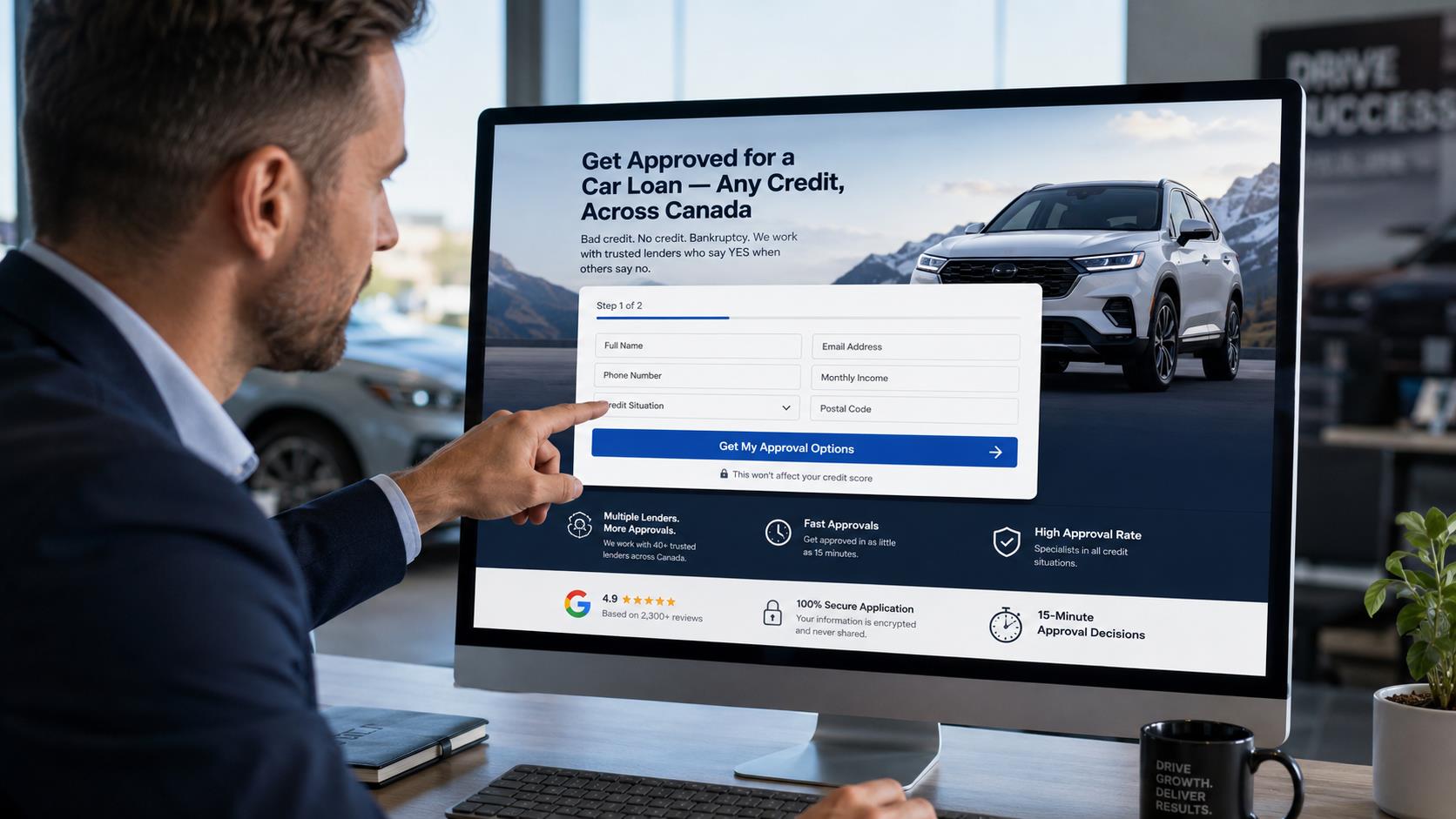
The single biggest lever in dealership PPC isn’t keywords or bids — it’s where you send the click. Vehicle Detail Pages convert paid traffic poorly because they’re built for browsers, not buyers. A finance-intent click deserves a finance-intent landing page: a single-purpose page where the credit application sits above the fold and everything else is supporting evidence.
The structure that consistently outperforms is straightforward. Headline that matches the ad’s promise (e.g., “Get Approved for a Car Loan — Any Credit, Across Canada”). Subhead that addresses the credit concern directly. A 4–6 field credit application form above the fold — name, email, phone, monthly income, credit situation, postal code. Trust signals beneath the form: lender logos, dealership reviews, approval timelines. A clear privacy and security statement. No navigation menu, no inventory grid, no distractions.
Form length is a constant trade-off. Shorter forms drive higher conversion rates but lower lead quality; longer forms filter for serious applicants. The sweet spot for most dealerships is a two-step form: collect basic contact info on step one, then progressive-disclose income and credit details on step two. This pattern typically lifts completion rates by 25–40% versus a single long form, while still capturing the qualifying data the F&I team needs.
AUTOCARLEADS
Tired of Paying for Clicks That Don’t Convert?
Get exclusive, pre-screened Canadian auto finance leads delivered in real time — no PPC management, no wasted spend, no shared leads.
- ✓ Minimum $1,800/month income verified by QA team
- ✓ AI-powered SMS follow-up within 5 minutes of lead delivery
- ✓ Lead buyback guarantee — no bad leads, no contract lock-in
Or call +1-888-510-0264
Ad Copy That Pre-Qualifies and Pre-Sells
Effective dealership ad copy does two jobs at once: it pre-qualifies the click and pre-sells the application. The headline should name the buyer’s credit situation directly — “Bad Credit? Get Approved.” or “Newcomer to Canada? Drive Today.” This filters out browsers who don’t fit the offer while signaling to qualified shoppers that they’re in the right place.
Responsive Search Ads should be loaded with 12–15 headlines and 4 descriptions, with key value props pinned to position one when they’re non-negotiable (the credit angle, the geographic qualifier). Always include numbers and specifics: “Approval in 24 Hours,” “Drive Off Today,” “$0 Down Options.” Avoid vague claims like “great rates” or “trusted dealer” — Google’s quality signals and human readers both reward specificity.
Ad extensions are free real estate that dealerships consistently underuse. Sitelink extensions should point to bad credit financing, no credit financing, application page, and inventory by price range. Callout extensions reinforce qualifying details: “All Credit Accepted,” “Same-Day Approval,” “150+ Lenders.” Structured snippets list vehicle types you finance. Call extensions are essential — a meaningful share of finance-intent clicks on mobile convert to phone calls, not form fills.
Speed-to-Lead: The Conversion Mechanic Most Dealers Ignore
Generating finance leads through Google Ads is only half the equation. The other half is what happens in the first five minutes after a lead submits an application. Research consistently shows that lead-to-contact time is the strongest predictor of close rate in automotive finance, and the dropoff after the first hour is steep.
Most dealership BDC teams operate on a 30–60 minute response window, which is functionally too slow for a lead who just submitted an application from a mobile phone while sitting in a competitor’s parking lot. The fix is automation: an immediate SMS confirmation triggered by the form submission, followed by a personalized call attempt within five minutes. Automated SMS alone can lift contact rates by 30–50%, and when paired with rapid human follow-up, drives meaningful improvements in funded-deal conversion.
This is also where the case for buying leads versus running PPC starts to crystallize for many dealers. Running a competent Google Ads program requires keyword research, landing page development, conversion tracking, bidding optimization, ad copy testing, and ongoing BDC follow-up infrastructure. For dealerships that don’t have the in-house capability or scale to justify that overhead, purchasing exclusive, pre-screened leads from a specialized provider often delivers a better cost-per-funded-deal — without the agency fees, ad spend volatility, or learning curve.
|
150+
Canadian dealerships served
|
180,000+
Applications processed
|
6–15%
Dealer conversion rate
|
Measuring What Matters: Conversion Tracking and Attribution
Most dealership Google Ads accounts track the wrong conversions. Form submissions and phone calls are leading indicators, not outcomes. The metric that should drive optimization decisions is cost-per-funded-deal, not cost-per-lead. A campaign delivering leads at $30 each that closes 2% of them is more expensive than a campaign delivering leads at $75 each that closes 12%.
Set up Google Ads conversion tracking with values assigned to each conversion type: form submissions, phone calls over 60 seconds, application completions, and — most importantly — funded deals imported back via offline conversion tracking. The offline conversion piece is where most accounts fall short. Without it, Google’s algorithm optimizes toward lead volume rather than lead quality, which inevitably degrades campaign performance over 90+ day windows.
GA4 should run in parallel for full-funnel attribution. Configure custom events for application starts, application completions, and credit submissions. Build conversion paths that distinguish between users who land on a finance page versus a VDP — these audiences behave differently and should be targeted differently in remarketing campaigns. Smart Bidding with imported funded-deal conversions and well-structured audience signals is where the meaningful PPC efficiency gains compound over time.
Key Takeaways
- Restructure campaigns around finance intent — bad credit, no credit, second chance, and bankruptcy financing — not just vehicle inventory.
- Send finance-intent clicks to a dedicated landing page with a 2-step credit application above the fold, not to a VDP or homepage.
- Start new campaigns on Manual CPC, then transition to Smart Bidding only after accumulating 30+ conversions in a 30-day window.
- Import funded-deal conversions back into Google Ads via offline tracking to optimize for cost-per-funded-deal, not cost-per-lead.
Frequently Asked Questions
How much should a car dealership spend on Google Ads each month?
Most independent Canadian dealerships running Google Ads effectively spend between $3,000 and $15,000 per month, with franchise dealers often spending $20,000–$50,000+. Budget should be calibrated to your average gross per deal and target cost-per-funded-deal, not to industry averages. A dealership averaging $2,500 gross per finance deal can typically support $400–$600 in marketing cost per funded deal while remaining profitable.
Are Google Ads better than buying auto finance leads?
It depends on scale and in-house capability. Google Ads can deliver lower cost-per-lead at scale if you have the team to manage campaigns, build landing pages, and follow up within five minutes. Buying pre-screened, exclusive leads from a provider like Autocarleads typically delivers a more predictable cost-per-funded-deal and avoids the 60–90 day ramp period required to optimize a PPC account. Many dealerships run both channels simultaneously to diversify lead supply.
What keywords convert best for car dealerships?
Finance-intent keywords consistently outperform inventory keywords for lead generation. The top-performing categories are bad credit auto loans, no credit auto loans, second chance car financing, bankruptcy auto loans, and zero down financing — especially when paired with city or province modifiers. Brand and model keywords still have a role for shoppers further down the funnel, but they typically deliver lower lead rates and higher CPCs.
Should dealerships use Performance Max campaigns?
Performance Max can be a useful supplement to search campaigns, but it shouldn’t replace them. PMax tends to cannibalize branded search traffic and inflate ROAS reporting if not properly structured. Best practice is to run PMax with a separate budget, exclude brand terms, and use it specifically to capture incremental conversions from YouTube, Display, and Gmail inventory while keeping core finance-intent traffic in standard search campaigns.
How fast should dealerships respond to Google Ads leads?
Under five minutes, ideally. Lead-to-contact time is the single strongest predictor of close rate in automotive finance, and the dropoff after the first hour is severe. Automated SMS confirmation triggered immediately by form submission, followed by a human call attempt within five minutes, will typically lift contact rates by 30–50% compared to a 30–60 minute response window.
What’s a realistic conversion rate for dealership Google Ads campaigns?
Well-structured dealership PPC campaigns with finance-intent landing pages typically convert clicks to leads at 8–15%, with funded-deal conversion rates of 4–8% on those leads. Combined, that translates to roughly $200–$600 in PPC cost per funded deal in most Canadian markets — though this varies significantly by lender mix, BDC strength, and the dealership’s ability to handle subprime applications.
AUTOCARLEADS
Fill Your Finance Pipeline Without the PPC Headache
Get exclusive, pre-screened Canadian auto finance leads delivered in real time, with AI SMS follow-up and a buyback guarantee — no ad spend volatility, no agency fees, no shared leads.
- ✅ 100% exclusive leads — never shared with another dealer
- ✅ Pre-screened with $1,800+ monthly income verified
- ✅ Lead buyback guarantee on disqualified applicants
- ✅ Geo-targeted to your dealership’s territory
📞 Call +1-888-510-0264 to start filling your sales floor with qualified buyers.